
CAF - Construcciones y Auxiliar de Ferrocarriles SA
CAF offers a compelling, undervalued play on the global green mobility transition, distinguished by a record-breaking, inflation-protected order book, a pristine balance sheet, and a rapidly expanding high-margin services division that is progressively de-risking the equity story.
Summary
Construcciones y Auxiliar de Ferrocarriles SA (CAF) represents a resilient, conservatively capitalized industrial equity situated at the convergence of two powerful structural megatrends: the decarbonization of global transport and the densification of urban centers. Headquartered in the Basque Country of Spain, CAF has evolved from a regional rolling stock manufacturer into a diversified multinational multinational leader in sustainable mobility, balancing its historical core in railway engineering with a dominant position in the European zero-emission bus market through its subsidiary, Solaris.
The company’s economic engine is powered by a hybrid business model that combines large-scale, cyclical manufacturing contracts with long-term, inflation-linked service agreements. As of the first half of 2025, CAF sits on a historic record backlog exceeding €15.6 billion, providing exceptional revenue visibility that extends nearly four years into the future. This backlog is not merely high in volume but high in quality, characterized by indexation clauses that protect margins against inflationary pressures—a critical differentiator in the current macroeconomic environment. Financially, CAF stands out among its peers for its prudent balance sheet management, boasting a net financial debt-to-EBITDA ratio of just 0.7x, which provides significant strategic optionality compared to more leveraged competitors like Alstom.
CAF’s competitive advantage is rooted in its strategic positioning as the "tailor of the railway industry." Unlike larger conglomerates that enforce rigid standardization to feed massive industrial footprints, CAF excels in flexibility, offering bespoke engineering solutions that allow it to win complex, high-value contracts in brownfield environments where standardized platforms fail. Simultaneously, its Solaris division commands a technological lead in hydrogen and battery-electric buses, securing a moat against commoditized competition through proprietary energy management systems and a massive installed base.
However, the investment thesis is not without risks. The company operates in a sector plagued by thin manufacturing margins and high execution risks, where a single delayed project can severely impact profitability. Supply chain volatility, particularly regarding components from Asia, and the inherent complexity of integrated "turnkey" projects remain persistent sources of uncertainty. Furthermore, while the valuation appears attractive relative to peers, the market continues to apply a "conglomerate discount" due to the complexity of valuing its diverse revenue streams.
1. What CAF sells and who buys it
Core Product Portfolio: A Multimodal Mobility Ecosystem
CAF’s commercial offering has expanded significantly beyond its traditional roots in railway manufacturing. The company now markets a comprehensive "multimodal" ecosystem that addresses the entire value chain of public transportation, from the vehicles themselves to the infrastructure they run on and the digital systems that manage them. This portfolio is structured around two primary industrial pillars—Rolling Stock and Buses—supported by transversal divisions for signalling, components, and services.
Railway Solutions (Rolling Stock)
The Railway segment remains the foundational pillar of CAF’s identity and revenue, accounting for approximately 52-55% of the total order backlog. The product range is exhaustive, designed to cover every distance category in passenger rail:
- High-Speed and Intercity Trains: CAF competes in the prestigious high-speed segment with its Oaris and Alvia platforms. The Oaris is capable of speeds up to 320 km/h, positioning CAF to compete for major intercity corridors. The Alvia series features variable-gauge technology, a critical capability for markets like Spain where the network is split between standard (UIC) and Iberian gauges. This ability to change axles on the fly is a niche technical competency that few competitors possess.
- Regional & Commuter Platforms (Civity): The Civity platform is the company's workhorse for regional transport. It is a modular low-floor train designed for maximum passenger capacity and accessibility. Crucially, the Civity platform is agnostic regarding power source; it can be configured as an Electric Multiple Unit (EMU), a Diesel Multiple Unit (DMU), or a Battery-Electric Multiple Unit (BEMU) for non-electrified lines. This flexibility has secured major contracts in the UK (Northern Rail), the Netherlands (NS), and Australia.
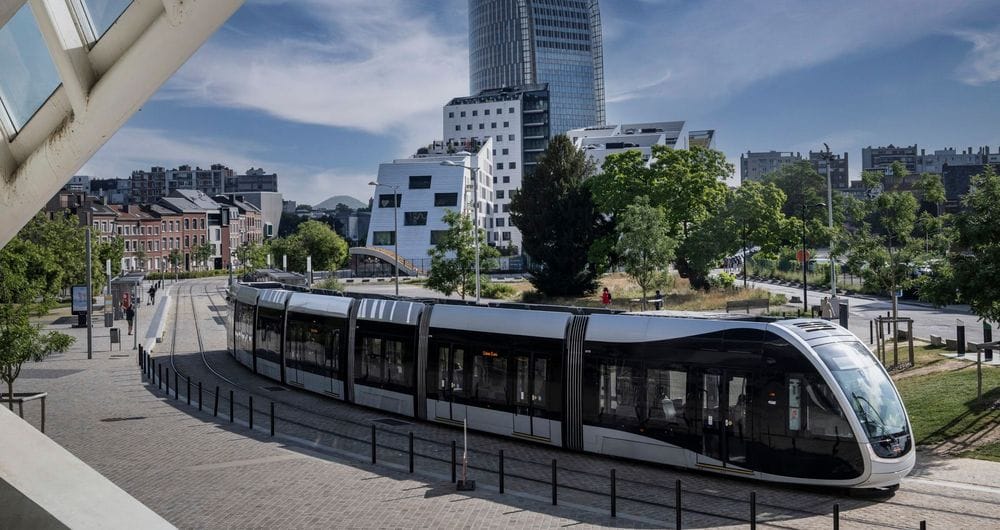
- Urban Transit (Urbos Trams & Inneo Metros): The Urbos tram family is perhaps CAF’s most successful export product. It features the proprietary "Greentech" system—an on-board energy storage solution using supercapacitors and batteries that allows trams to operate without overhead catenary wires. This is a decisive selling point for historic city centers (e.g., Seville, Birmingham, Zaragoza) where preserving architectural aesthetics is a priority for municipal clients. The Inneo metro platform serves heavy urban transit needs, with units operating in global capitals such as Madrid, Rome, and Brussels.
- Locomotives: CAF manufactures heavy-haul and passenger locomotives, including the Bitrac platform, which offers dual-mode (electric and diesel) propulsion, allowing operators to run seamlessly across electrified and non-electrified tracks.
Urban Buses (Solaris)
Through its 2018 acquisition of Solaris Bus & Coach, CAF secured a dominant position in the European urban bus market. Solaris is not merely a subsidiary; it is the growth engine of the group’s decarbonization strategy. The product portfolio is aggressively oriented toward alternative propulsion:
- Zero-Emission Leaders: The Urbino Electric and Urbino Hydrogen families are the flagship products. The Urbino Hydrogen has captured a market-leading position, accounting for 69% of the European hydrogen bus market share in 2024. These vehicles utilize hydrogen fuel cells to generate electricity on board, offering ranges comparable to diesel buses without the emissions—a critical capability for operators with long daily routes that battery-electric buses cannot yet serve efficiently.
- Trolleybuses: Leveraging decades of experience, Solaris remains a global leader in trolleybuses (buses powered by overhead wires), often enhancing them with batteries for off-wire capability (Trollino series).
Integrated Systems and Services
Beyond the vehicle hardware, CAF sells operational certainty. The "Turnkey" or "Integrated Solutions" division packages the train with the civil works, electrification, and signalling systems required to run it. This is particularly attractive to emerging markets or cities building their first transit lines (e.g., the Tel Aviv Light Rail or projects in Jerusalem and Parramatta). The "Services" division provides long-term maintenance, refurbishment, and digital fleet management through the LeadMind platform, which uses big data to predict component failures before they occur.
Target Customers and Motivations
CAF’s customer base is almost exclusively comprised of public or quasi-public entities, creating a credit profile that is essentially sovereign-risk.
- Public Transit Operators (PTOs): National operators like SNCF (France), Renfe (Spain), Deutsche Bahn (Germany), and municipal entities like Metro de Madrid or GVB Amsterdam form the core client base.
- Motivation: These customers are driven by strict public policy mandates. The European Union’s Green Deal requires a modal shift from road/air to rail, forcing operators to expand fleets. Furthermore, aging fleets from the 1980s and 1990s are reaching the end of their lifecycle, necessitating replacement with modern, energy-efficient vehicles to meet carbon reduction targets.
- Municipalities and Regional Governments: Cities are the primary buyers of trams and buses. Clients range from the City of Oslo to King County Metro in Seattle.
- Motivation: Urban congestion and local air quality are the primary drivers. Cities are banning diesel buses from centers, creating a forced replacement cycle where CAF’s Solaris electric/hydrogen buses are the solution to regulatory compliance.
- Private Franchise Operators: In liberalized markets like the UK, private companies (e.g., Arriva, FirstGroup) bid to run rail franchises.
- Motivation: These profit-driven entities prioritize Total Cost of Ownership (TCO), reliability, and passenger experience to meet franchise commitments and maximize ridership revenue.
2. How CAF makes money
Revenue Model
CAF operates a hybrid revenue model that balances the lumpiness of construction contracts with the stability of recurring services. Understanding the mechanics of revenue recognition is crucial for interpreting the company’s financials.
- Manufacturing Revenue (Project-Based):
- Mechanism: The majority of revenue is derived from the design and manufacture of trains and buses. This revenue is recognized over time using the Percentage of Completion (PoC) method. As CAF incurs costs (labor hours, materials), it recognizes a proportional amount of revenue. This avoids massive revenue spikes only occurring upon delivery.
- Payment Structure: These contracts are cash-intensive. Typically, customers pay an advance (10-20%) upon signing, followed by milestone payments (e.g., completion of design, arrival of car shells, first train testing), and a final retention payment upon acceptance.
- Characteristics: This stream drives the top-line volume but carries lower margins (typically 4-6% EBIT) and high working capital volatility.
- Services Revenue (Recurring):
- Mechanism: This segment involves long-term Operations & Maintenance (O&M) contracts that can span 15 to 30 years. Revenue is generated based on performance metrics such as fleet availability, kilometers traveled, or fixed monthly management fees.
- Pricing: Service contracts often include inflation indexation formulas that automatically adjust fees based on labor and consumer price indices, providing a hedge against inflation.
- Characteristics: This is the highest-quality revenue stream, offering higher margins (10-15%+) and predictable cash flows that are decoupled from the manufacturing cycle.
- Integrated Solutions (Turnkey):
- Mechanism: These are massive, lump-sum contracts for delivering entire transit systems. CAF acts as the general contractor, managing subcontractors for civil works (track laying, stations).
- Characteristics: These projects generate massive revenue but carry significant risk. Margins are often thin on the construction side, with the real value captured in the embedded supply of trains and the subsequent long-term maintenance tail.
Revenue Segments and Share
Based on the financial data from H1 2025 and the full year 2024, the revenue composition reflects a diversified industrial group:
| Revenue Segment | Approx. Share | Dynamics |
|---|---|---|
| Rolling Stock (Rail) | ~52-55% | The core volume driver. Growth is currently fueled by the execution of the record backlog accumulated in 2023-2024. |
| Buses (Solaris) | ~25-30% | The growth engine. In H1 2025, bus revenue grew significantly due to a 16% increase in delivery volumes, driven by the shift to higher-priced zero-emission units. |
| Services | ~15-20% | The strategic priority. This segment grew by 16% in H1 2025, outpacing group growth, as new fleets delivered in previous years enter their maintenance phase. |
| Integrated Solutions | ~10% | The variable component. Revenue contribution fluctuates based on the construction phases of large projects (e.g., Tel Aviv, Jerusalem). |
3. Quality of Revenue
Predictability and Backlog Visibility
CAF’s revenue quality is exceptionally high, underpinned by a massive and legally binding order backlog. As of mid-2025, the backlog reached a historic peak of €15.6 billion.
- Coverage: This backlog represents approximately 3.7 times the company's annual revenue. In practical terms, this means CAF’s factories are effectively booked solid for the next nearly four years. This level of visibility is rare in the industrial sector and insulates the company from short-term macroeconomic demand shocks.
- Book-to-Bill Ratio: The company consistently maintains a book-to-bill ratio above 1.0, reaching 1.4x in H1 2025. This metric indicates that for every €100 of revenue recognized, CAF secured €140 in new orders, signaling an accelerating growth trajectory rather than stagnation.
- The "Shadow" Backlog: Beyond the firm backlog, CAF holds over €7 billion in unexercised options. These are pre-negotiated extensions to existing contracts (e.g., a city ordering 40 trams with an option for 20 more). Options are highly lucrative as they require zero additional sales effort and utilize existing engineering designs, translating to higher margins when exercised.
Diversification
The revenue stream is well-diversified, mitigating concentration risk:
- Geographic Balance: While Europe remains the anchor market (accounting for ~66-70% of the backlog), CAF has successfully diversified into stable, high-value international markets. The expansion of Solaris into North America (USA/Canada) is a critical development, creating a natural currency hedge (USD revenues) and reducing dependence on the Eurozone economy.
- Segment Counter-Cyclicality: The bus and rail cycles often move at different speeds. Bus contracts are shorter-cycle (6-18 months), providing quick cash conversion, while rail projects are long-cycle (3-5 years), providing baseline load. Having both under one roof smooths the aggregate cash flow profile.
Inflation Protection (Indexation)
A critical feature of CAF’s revenue quality in the post-2022 inflation era is the structural protection embedded in its contracts.
- Indexation Clauses: Approximately 70-80% of the backlog is covered by price revision formulas. These clauses automatically adjust the contract price based on published indices for key cost inputs: labor (wage inflation), energy, and raw materials (steel, aluminum).
- The Lag Effect: While effective, these mechanisms have a time lag. A spike in steel prices today may not be reflected in client payments for 6-12 months. However, as the older, non-indexed contracts (signed pre-2022) are delivered and replaced by new, fully indexed contracts, the gross margin profile is structurally improving.
4. Cost Structure
Major Cost Factors
CAF operates a heavy manufacturing business model characterized by significant variable costs and rigid fixed costs. Understanding this structure is key to analyzing its operating leverage.
- Procurement (Materials): This is the single largest cost driver, accounting for approximately 56% of total revenue.
- Components: This includes raw commodities (steel, aluminum, copper) and high-value sub-systems (batteries for Solaris, traction converters, braking systems, HVAC).
- Volatility: The cost of lithium and battery cells is a major variable for the bus division, though long-term supply agreements and indexation clauses help mitigate this volatility.
- Personnel (Labor): Staff costs are the second largest component, representing approximately 26% of revenue.
- Rigidity: CAF’s primary manufacturing hubs are in Spain (Beasain, Zaragoza), France (Reichshoffen), and Poland (Solaris). In Spain and France, labor laws make the workforce a relatively fixed cost in the short to medium term. The company cannot easily flex its headcount down during demand lulls, which makes volume throughput critical for absorption.
- Skill Premium: The workforce is highly skilled (welding certifications, electrical engineering), commanding higher wages than general assembly labor.
- Other Operating Expenses: These account for ~14% of revenue and cover energy, logistics, external engineering services, and overheads.
Margin Evolution and Scalability
- EBIT Margin Trends: CAF’s operating margin (EBIT) has shown a positive trajectory, expanding to 5.2% - 5.5% in H1 2025 (up from 4.7% in 2023).
- The "Solaris Leap": The bus segment has undergone a structural profitability shift. Historically a lower-margin business, Solaris achieved an EBIT margin of 5.5% in H1 2025.6 This expansion is driven by the product mix shift: electric and hydrogen buses command significantly higher unit prices and margins than the diesel buses they replace.
- Scalability: The business exhibits moderate scalability.
- Manufacturing: Scaling production requires linear increases in floor space and working capital.
- Engineering: There is high operating leverage in engineering. Designing a train platform (like the Civity) costs the same whether CAF sells 10 units or 100 units. Therefore, exercising contract options (which use existing designs) is the most profitable growth mechanism.
- Services: This is the most scalable division. A maintenance depot can often service additional trains with minimal incremental fixed investment, driving margin expansion as fleet density increases.
5. Capital Intensity
Asset Requirements
CAF is a capital-intensive industrial enterprise. It requires a vast physical footprint to operate:
- Industrial Footprint: The company operates massive assembly halls with overhead cranes, testing tracks, and painting facilities. Key sites include Beasain and Zaragoza in Spain, the recently acquired Reichshoffen plant in France, Newport in the UK, and the Solaris facility in Bolechowo, Poland.
- R&D Assets: Continuous investment is required in testing laboratories for new technologies, such as hydrogen fuel cell integration and autonomous driving systems for trams.
CapEx Cycle
- Level of Expenditure: Annual Capital Expenditure (CapEx) typically runs at approximately €100 million, or roughly 2-3% of sales. This level indicates a mature asset base where investment is focused on maintenance, modernization, and digitization rather than massive greenfield expansion.
- Strategic Investments: Recent CapEx has been directed toward adapting factories for hydrogen bus production and integrating the Reichshoffen plant (acquired from Alstom).
Working Capital and Cash Conversion
Working Capital (NWC) is the lifeblood of CAF’s operations and its most critical financial metric.
- The Funding Gap: The business model requires heavy upfront cash outflows to procure materials (batteries, steel) months before a train is completed.
- Customer Financing: To mitigate this, CAF relies on "down payments" and milestone payments from customers.
- Current Dynamic: In H1 2025, the company experienced negative cash flow from operations due to a significant consumption of working capital (€88 million outflow).
- Analysis: This "investment in working capital" is a leading indicator of growth. CAF is building inventory to execute its record backlog. While it depresses cash conversion in the short term, it is a precursor to future revenue recognition.
- Cash Conversion Efficiency: Generally, conversion is slow due to the long production cycles (up to 2-3 years for a train), but the high credit quality of customers (governments) means bad debt risk is negligible.
6. Growth Drivers
1. Structural Megatrend: Decarbonization (Long-Term)
The primary engine of CAF’s growth is the global political mandate to decarbonize.
- The Mechanism: The European Green Deal and the US Infrastructure Investment and Jobs Act (IIJA) are funneling hundreds of billions of dollars into public transit. This is not cyclical demand; it is a structural replacement cycle. Cities must replace diesel buses with zero-emission alternatives by mandated deadlines (e.g., 2030 or 2035).
- Impact: This ensures sustained demand for Solaris’s EV and Hydrogen buses for the next decade, independent of minor economic fluctuations.
2. Services Division Expansion (Structural)
CAF is executing a strategic pivot to become a "Transport as a Service" provider.
- The Lever: Every train or bus sold creates a 30-year tail of maintenance revenue. CAF is aggressively capturing this by bundling maintenance with manufacturing bids.
- Growth: The Services division grew 16% in H1 2025. Managing over 150 contracts in 20 countries creates a recurring revenue base that stabilizes the group's earnings profile and warrants a higher valuation multiple.
3. Geographic Expansion: The North American Frontier (Medium-Term)
Solaris is breaking out of Europe.
- The Event: The entry of Solaris into the North American market (USA and Canada) is a game-changer.
- Why it Matters: The US transit market is vast and heavily subsidized, but difficult to enter due to "Buy America" regulations. CAF’s existing manufacturing footprint in the US (Elmira, NY) provides the industrial base to localize Solaris production, bypassing tariffs and unlocking access to federal funding. Initial contracts in Seattle and Canada serve as proof-of-concept for this expansion.
4. Market Consolidation (Cyclical)
The rail industry is consolidating. The merger of Alstom and Bombardier created a distracted giant, forcing regulators to mandate asset divestitures.
- The Opportunity: CAF capitalized on this by acquiring the Reichshoffen plant and the Coradia Polyvalent platform. This opportunistic M&A allows CAF to instantly acquire order books, technology, and skilled labor, leapfrogging years of organic growth.
7. Competitive Advantages
1. Flexibility: "The Tailor of the Railway"
CAF’s defining advantage is its willingness and ability to customize.
- The Contrast: Competitors like Alstom and Siemens prioritize the "iPhone model"—standardized platforms produced in massive volume. They are reluctant to alter designs for small orders.
- The CAF Edge: CAF’s engineering culture and manufacturing processes are optimized for high-complexity, medium-volume batches. This makes CAF the partner of choice for "brownfield" projects—older cities with unique track gauges, tight tunnel clearances, or specific voltage requirements where a standard off-the-shelf train simply won’t fit. This creates a moat around complex, niche tenders.
2. Solaris: Technology Leadership in Hydrogen
In the bus segment, Solaris possesses a genuine technological moat.
- Market Dominance: Solaris is not just a participant; it is the market maker. With a 69% share of the hydrogen bus market in 2024, it has established the de facto standard for the industry.
- The Barrier: Integrating hydrogen fuel cells is technically difficult. It requires sophisticated thermal management and safety systems. Solaris’s accumulated field data from hundreds of operating buses gives it a reliability advantage that new entrants (or Chinese competitors focusing purely on batteries) cannot easily replicate.
3. Vertical Integration
CAF is more vertically integrated than many peers.
- Internal Capabilities: Through subsidiaries like MiiRA (axles and wheels) and CAF Power & Automation (traction converters, energy storage), CAF controls critical sub-systems.
- Benefit: This captures margin that would otherwise go to suppliers and reduces dependency on external supply chains, improving delivery reliability.
8. Industry Structure and Position
Value Chain Analysis
The rail value chain is stratified into four layers:
- Component Suppliers: Providers of brakes (Knorr-Bremse), doors, and raw materials.
- System Integrators (OEMs): This is where CAF sits. These companies design the vehicle, manufacture the car body, integrate all systems, and certify the train for operation. This is the highest value-add step.
- Operators: The entities that run the trains (SNCF, Amtrak).
- Maintenance Providers: Often the OEMs themselves or in-house teams.
Market Structure: A Global Oligopoly
The industry is consolidated, with high barriers to entry (capital requirements, safety certifications).
- Tier 1 (The Giants): CRRC (China) is the global volume leader but is largely locked out of Western markets due to geopolitical concerns. Alstom and Siemens are the Western giants, dominating high-speed rail and massive metro tenders.
- Tier 2 (The Challengers): CAF and Stadler occupy this tier. They are large enough to compete globally but small enough to be agile.
- Relative Size: CAF (Revenue ~€4bn) is smaller than Alstom (~€17-18bn) but competes effectively by targeting segments where agility matters more than raw scale.
CAF’s Position: The Agile Specialist
CAF acts as a "Price Setter" in specialized niches (e.g., hydrogen buses, catenary-free trams) where its technology is unique. In commoditized segments like standard metro cars, it acts as a "Price Taker," often winning on aggressive pricing or local content offers.
- Market Share: Globally, the top 10 manufacturers control ~70% of the market. CAF is firmly established in this top tier, gaining share in Europe at the expense of struggling legacy players.
9. Unit Economics and Key Performance Indicators
Bus Segment (Solaris) Economics
- Average Selling Price (ASP): The unit economics of the bus division are transforming. Based on H1 2025 revenue of approx. €519m and 765 deliveries, the implied ASP is ~€678,000 per bus.
- Insight: This is significantly higher than the historical norm for diesel buses (~€250k). The shift to electric and hydrogen models has effectively tripled the revenue potential per unit.
- Volume Trend: Deliveries grew 6% YoY in H1 2025.
- Zero-Emission Ratio: 68% of deliveries were zero-emission. This ratio is the key KPI to watch; as it climbs, blended margins expand due to the higher value-add of complex electric/hydrogen drivetrains.
Railway KPIs
- Book-to-Bill Ratio: 1.4x (H1 2025).
- Analysis: A ratio >1.0 indicates a growing backlog. A ratio of 1.4x is aggressive growth, implying that future revenue growth is mathematically locked in.
- Backlog Duration: ~3.7 years.
- Analysis: This metric provides stability. Unlike consumer goods companies that need to resell their inventory every quarter, CAF wakes up on January 1st with 80-90% of its annual revenue already secured in the backlog.
10. Capital Allocation and Balance Sheet
Balance Sheet Strength
CAF’s financial management is characterized by deep conservatism, a stark contrast to the aggressive leverage seen elsewhere in the sector.
- Leverage Ratio: Net Financial Debt / EBITDA stands at 0.7x.
- Context: This is an "investment grade" profile. It provides a massive buffer against rising interest rates and creates strategic optionality. While Alstom is forced to sell assets to service debt, CAF has the capacity to acquire distressed assets or invest in R&D.
- Liquidity: The company holds €1.16 billion in available liquidity (Cash + Undrawn Credit Lines). This ensures that the negative working capital cycles inherent in large projects never threaten solvency.
Capital Allocation History
- Organic Growth (Priority): The primary use of capital is funding the working capital needs of the backlog.
- Dividends (Shareholder Returns): CAF has a reliable dividend history. The 2024 proposal was €1.34 per share, representing a 21% increase year-over-year. This implies a payout ratio of roughly 35-40%, striking a balance between reinvestment and yield.
- M&A (Strategic): The allocation to M&A has been disciplined and value-accretive. The acquisition of Solaris (2018) for ~€300m was a masterstroke, purchasing a future growth engine at a reasonable multiple before the "green bus" boom fully materialized.
- Debt Reduction: Long-term debt has been reduced from €256m to €226m, further de-risking the equity.
Value Creation Assessment
Capital allocation has unequivocally Created Value. The management team avoided the temptation of "empire building" mega-mergers that plagued competitors (e.g., the Alstom-Bombardier integration nightmare) and instead focused on targeted, technological acquisitions (Solaris, Reichshoffen) that enhanced their competitive moat.
11. Risks and Sources of Error
1. Execution and Penalties (Operational Risk)
The rail industry is notorious for penalty clauses. Contracts often stipulate severe fines for late delivery or reliability issues.
- The "Talgo/Renfe" Warning: Competitor Talgo recently faced a massive €116m penalty from Renfe for delays. CAF is not immune to this. A failure to deliver the new Civity trains on time due to component shortages could trigger similar penalties, instantly wiping out project margins.
2. Supply Chain Volatility (Macro Risk)
- Dependence: CAF relies on a global supply chain for chips, steel, and batteries.
- The Risk: While contracts are indexed, indexation lags reality. A sudden geopolitical shock (e.g., a blockade of the Taiwan Strait affecting chip supply) would halt production lines, preventing revenue recognition while fixed labor costs continue to burn cash.
3. Integrated Project Risks (Construction Risk)
- Complexity: "Turnkey" projects involve civil engineering (digging tunnels, laying track). These are subject to permitting delays, geological surprises, and local labor disputes.
- Impact: In H1 2025, revenue from Integrated Solutions fell because of "lower contribution from turnkey projects". This lumpiness can cause earnings volatility that scares investors accustomed to linear growth.
4. Technological Bet (Strategic Risk)
- Hydrogen Uncertainty: CAF/Solaris is heavily invested in hydrogen. If the market decisively shifts solely to battery-electric (due to cheaper batteries) and abandons hydrogen infrastructure, CAF’s R&D investment and specific manufacturing lines could become stranded assets.
12. Valuation and Expected Return Profile
Valuation Context
CAF typically trades at a discount to "pure-play" peers due to its conglomerate structure and lower liquidity.
- Current Multiples: Based on 2025 estimates, CAF trades at an EV/EBITDA of approximately 6.6x - 7.9x.
- Peer Comparison:
- Stadler Rail: Often commands a premium (10-12x EV/EBITDA) due to its reputation for Swiss precision and higher margins.
- Alstom: Trades at volatile multiples due to its restructuring, but historically 8-10x.
- The Gap: CAF’s 0.7x leverage vs. peers' higher debt loads suggests it is fundamentally undervalued. The market is pricing it as a cyclical industrial rather than a growth-oriented green mobility player.
Scenario Framework
| Scenario | Narrative | Assumptions | Valuation Outcome |
|---|---|---|---|
| Bear Case | Supply chain crisis re-emerges; major execution penalties (e.g., Renfe); EU green subsidies cut due to austerity. | Margins contract to <4%. Revenue growth stalls. | Stock re-rates to 5x EBITDA. Downside Potential: ~25-30% |
| Base Case | Backlog executes smoothly at ~5.5% margin. Solaris continues US expansion. Services grow at 10%. | Revenue grows high single digits. Margins stable. | Stock maintains 7x EBITDA. Earnings growth drives returns. Upside Potential: ~15% (Fair Value) |
| Bull Case | Margins expand to 7% (operating leverage kicks in). Services mix reaches 25%. Solaris wins major US mega-tender. | Market re-rates stock to 9-10x EBITDA (Stadler parity). | Multiple expansion + Earnings growth. Upside Potential: ~50%+ |
13. Catalysts and Time Horizon
Short-Term Catalysts (6-12 Months)
- Contract Finalization: The formal signing of the contract with SNCB (Belgium) for intercity trains, where CAF has been named preferred bidder, would add hundreds of millions to the backlog and validate its competitiveness in Northern Europe.
- Solaris US Traction: Announcements of follow-on orders from initial US customers (Seattle, San Francisco) would prove that the North American expansion strategy is gaining momentum and isn't just a one-off experiment.
Medium-Term Catalysts (12-36 Months)
- Service Mix Re-rating: If the Services division consistently grows faster than manufacturing and crosses the 20% revenue threshold, analysts will likely re-rate the stock with a higher multiple, viewing it less as a "factory" and more as a "utility."
- Hydrogen Infrastructure Rollout: Widespread deployment of hydrogen fueling stations in the EU would unleash the latent demand for Solaris’s hydrogen buses, accelerating volume growth.
Time Horizon
This is a medium-to-long-term hold (18-36 months). The thesis relies on the gradual execution of the backlog and the structural improvement of margins as legacy contracts burn off. It is not a quick trading stock; the value unlock is tied to the multi-year delivery cycles of the underlying industrial contracts. The market will recognize the value as the "Services" revenue line creates a floor for earnings that is visible and growing.
References
- Resultados anuales 2024 | CAF, accessed January 17, 2026 https://www.cafmobility.com/sala-prensa/resultados-anuales-2024/
- CAF H1 2025 presentation: Record order intake drives 40% profit growth - Investing.com, accessed January 17, 2026 https://www.investing.com/news/company-news/caf-h1-2025-presentation-record-order-intake-drives-40-profit-growth-93CH-4155742
- CAF H1 2025 presentation: Record order intake drives 40% profit growth - Investing.com Canada, accessed on January 17, 2026 https://ca.investing.com/news/company-news/caf-h1-2025-presentation-record-order-intake-drives-40-profit-growth-93CH-4121940
- CAF Q1 2025 slides: Revenue up 11%, profit jumps 53% amid record order backlog, accessed January 17, 2026 https://www.investing.com/news/company-news/caf-q1-2025-slides-revenue-up-11-profit-jumps-53-amid-record-order-backlog-93CH-4033477
- Full year 2024 results - CAF USA, accessed on January 17, 2026 https://admin.cafmobility.com/uploads/FY_2024_Results_02e86a5050.pdf
- Presentación de PowerPoint - CAF Mobility, accessed January 17, 2026 https://admin.cafmobility.com/uploads/H1_2025_Results_Presentation_09e559d1cb.pdf
- CONSTRUCCIONES Y AUXILIAR DE ... - CAF Mobility, accessed on January 18, 2026 https://admin.cafmobility.com/uploads/Informe_de_Gestion_y_Estados_Financieros_semestral_2024_EN_b848e75a51.pdf
- January-September 2024 Results, accessed on January 17, 2026 https://admin.cafmobility.com/uploads/3_T2024_en_4a7d01de30.pdf
- report - 2024 - CAF Mobility, accessed January 18, 2026 https://admin.cafmobility.com/uploads/CAF_2024_english_764e86c619.pdf
- Army Outlook - Canadian Association of Defence and Security Industries, accessed on January 18, 2026 https://www.defenceandsecurity.ca/CAF/caf/army-outlook
- CAF to Deliver 40 New Trains to Metro de Madrid | Railway-News, accessed January 17, 2026 https://railway-news.com/caf-to-deliver-40-new-trains-to-metro-de-madrid/
- CONSTRUCCIONES Y AUXILIAR DE FERROCARRILES, S.A. AND SUBSIDIARIES COMPOSING THE CAF GROUP (CONSOLIDATED) 2022 FIRST HALF-YEAR RE, accessed on January 18, 2026 https://admin.cafmobility.com/uploads/Informe_de_Gestion_y_Estados_Financieros_1er_Semestre_de_2022_EN_f86431da99.pdf
- Solaris to supply nearly 150 electric buses to the Netherlands and Poland - CAF Mobility, accessed on January 18, 2026 https://www.cafmobility.com/en/press-room/solaris-150-buses-netherlands-poland/
- Solaris buses head to San Francisco! Another milestone order in the US, accessed on January 18, 2026 https://www.solarisbus.com/en/press/solaris-buses-head-to-san-francisco-another-milestone-order-in-the-u-s-2377
- What is Growth Strategy and Future Prospects of CAF Company? - PESTEL Analysis, accessed on January 18, 2026 https://pestel-analysis.com/blogs/growth-strategy/caf
- Departmental Plan 2025-26 - Canada.ca, accessed on January 18, 2026 https://www.canada.ca/en/department-national-defence/corporate/reports-publications/departmental-plans/departmental-plan-2025-26.html
- Latest passenger rolling stock procurements and supplies: Alstom, CAF, Stadler, Škoda Group, TMH | ROLLINGSTOCK, accessed on January 18, 2026 https://rollingstockworld.com/passenger-cars/latest-passenger-rolling-stock-procurements-and-supplies-alstom-caf-stadler-skoda-group-tmh/
- FY 2024/25: Alstom delivers solid profit and cash. Medium-term ambitions confirmed, accessed on January 18, 2026 https://www.alstom.com/press-releases-news/2025/5/fy-202425-alstom-delivers-solid-profit-and-cash-medium-term-ambitions-confirmed
- 70% of the global rail market is in the hands of 10 manufacturers – here's how they rank, accessed on January 18, 2026 https://www.railtech.com/all/2025/07/02/70-of-the-global-rail-market-is-in-the-hands-of-10-manufacturers-heres-how-they-rank/
- CAF and Talgo report 2024 financial results - RAILMARKET.com, accessed on January 18, 2026 https://railmarket.com/news/business/30655-caf-and-talgo-report-2024-financial-results
- CAF - Public Comps and Valuation Multiples, accessed on January 18, 2026 https://multiples.vc/public-comps/caf-valuation-multiples