
Maschinenfabrik Berthold Hermle
Hermle is a premier, debt-free technology leader in 5-axis machining that offers investors exposure to the long-term automation super-cycle and a resilient dividend yield, currently trading at fair value amidst a cyclical trough.
Summary
Maschinenfabrik Berthold Hermle AG (Hermle) is a distinctive player in the global machine tool industry, operating not as a volume manufacturer but as a specialized boutique focused exclusively on high-precision 5-axis milling centers and integrated automation solutions. Headquartered in Gosheim, Germany, the company serves a clientele that demands extreme accuracy and surface quality, such as medical technology manufacturers producing titanium implants, aerospace suppliers machining turbine blisks, and high-end mold makers.
Economically, Hermle represents a "quality compounder" with a fortress-like balance sheet. Unlike many capital goods peers that rely on leverage to fuel expansion, Hermle operates with a net cash position and an equity ratio consistently exceeding 70%. The company’s financial model is characterized by high operating leverage and a unique "breathing" cost structure—facilitated by flexible working time accounts—which allows it to absorb cyclical downturns without shedding its highly skilled workforce. While revenue is inherently cyclical, tied to global industrial CapEx budgets, the company generates best-in-class operating margins (historically 15-20% EBIT margins), far outperforming larger competitors like DMG Mori.
However, the company currently faces significant headwinds. The fiscal year 2024 and early 2025 have been marked by a cyclical contraction, exacerbated by structural weakness in the domestic German market and the automotive sector. The order backlog has depleted, forcing the company to rely on its flexible labor model to preserve profitability as capacity utilization drops. Despite this, the company continues to invest heavily in its "Generation 2" product lineup and manufacturing capacity in Zimmern, positioning itself for the inevitable recovery.
1. What They Sell and Who Buys It
Core Product Portfolio: The Mastery of 5-Axis Milling
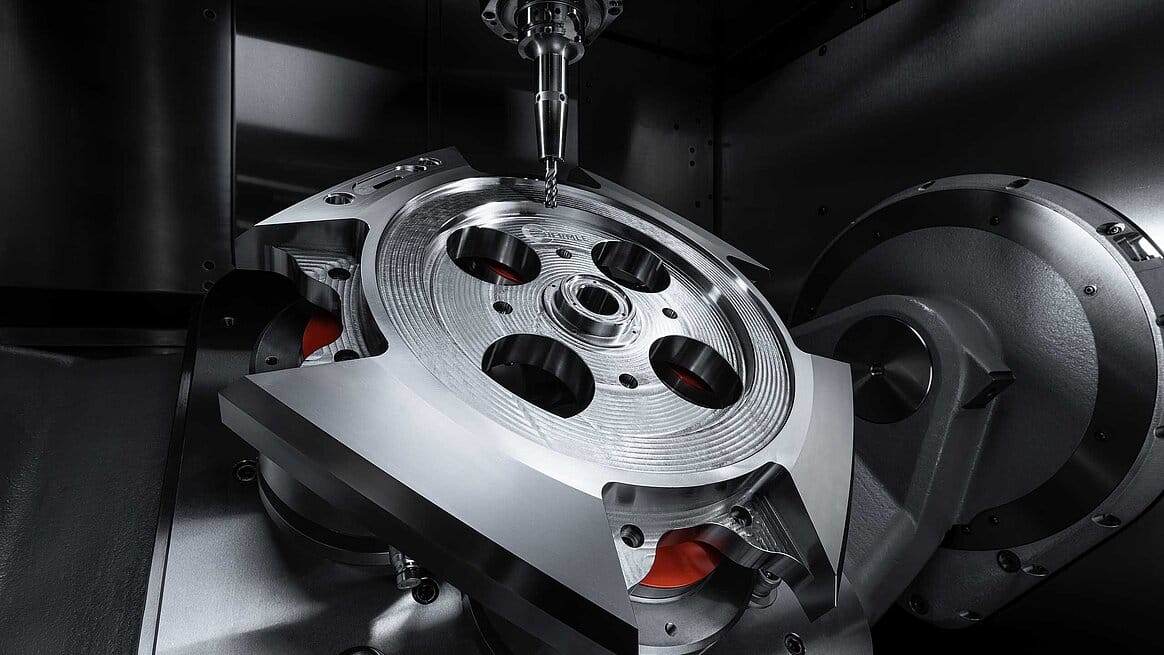
Hermle does not aim to be a generalist "department store" for machine tools. Instead, it focuses relentlessly on a specific technological niche: 5-axis vertical machining centers. In the hierarchy of subtractive manufacturing, 5-axis milling represents the pinnacle of complexity and capability, allowing a cutting tool to approach a workpiece from virtually any angle. This capability is essential for producing complex geometries—such as the impeller of a turbocharger or a cranial implant—in a single setup, reducing error-prone re-clamping and drastically improving efficiency.
The product portfolio is bifurcated into two primary lines, both of which share the company's proprietary mineral casting technology but target different market segments:
The High-Performance Line (C-Series)
This is the technological flagship of the company, comprising models such as the C 12, C 22, C 32, C 42, C 52, and C 62.8 These machines are distinguished by their "modified gantry design," an architectural choice that ensures high rigidity and dynamic precision.
- Target Application: These machines are designed for the most demanding tasks where tolerances are measured in microns and surface finish quality is paramount.
- Technological Edge: A critical differentiator is the mineral cast machine bed. Manufactured in Hermle’s dedicated facility in Zimmern ob Rottweil, this material has vibration-damping properties up to ten times superior to the grey cast iron used by many competitors. This results in longer tool life and superior surface quality, a non-negotiable factor for customers in optics or medical technology.
The Performance Line
Recognizing the need to address the mid-market without diluting its premium brand, Hermle introduced the Performance Line (e.g., C 250, C 400, C 650).
- Differentiation: These machines utilize the same core high-quality components and mineral cast beds as the High-Performance line but come with standardized configurations and fewer option permutations.
- Strategic Rationale: This allows Hermle to offer a more price-competitive entry point for job shops and subcontractors who require 5-axis capability but do not need the extreme customization of the High-Performance line.
Integrated Automation Solutions
Hermle has evolved from a machine builder to a systems integrator. The company develops and manufactures its own automation components, creating a closed ecosystem that locks customers in.
- Robot Systems (RS): Fully integrated robot cells (e.g., RS 05-2, RS 1) that can load heavy workpieces (up to hundreds of kilograms) automatically, enabling 24/7 "ghost shift" production.
- Pallet Changers (HS flex): Handling systems that swap pallets of raw materials, allowing for high-mix, low-volume production runs without operator intervention.
- Strategic Importance: Automation is no longer an "add-on" but a central driver of sales. As skilled labor becomes scarcer, customers are forced to automate. Hermle’s ability to provide a single-source solution (machine + robot + software) eliminates the integration headaches associated with third-party automation.
Digitalization and Additive Manufacturing
- Digital Modules: Hermle offers a suite of software tools (Digital Production, Digital Service) that enable machine monitoring, predictive maintenance, and transparent tool management, aligning with Industry 4.0 trends.
- MPA Technology: The company has developed a proprietary Metal Powder Application (MPA) technology for additive manufacturing. Unlike laser sintering, this thermal spray process allows for the creation of multi-material components (e.g., copper and tool steel) with integrated cooling channels, targeting the high-end mold-making and aerospace sectors.
Target Customers and Segmentation
Hermle’s customer base is defined by the complexity of the part rather than the industry vertical alone. The company deliberately avoids the high-volume, low-margin automotive powertrain market (e.g., engine blocks), which is commoditized and dominated by competitors like Grob. Instead, Hermle thrives in high-mix, precision-critical environments.
| Customer Segment | Key Motivation for Buying Hermle | Typical Applications |
|---|---|---|
| Medical Technology | Surface Quality & Biocompatibility. Medical implants require mirror-like finishes that reduce the need for manual polishing. Reliability is critical; a machine failure can halt a validated production line. | Titanium hip/knee implants, surgical instruments, bone plates. |
| Aerospace | Rigidity & Precision. Machining superalloys (Inconel, Titanium) requires immense machine rigidity to prevent chatter. Parts like blisks are extremely expensive; scrap is unacceptable. | Blisks (blade integrated disks), structural brackets, engine casings. |
| Tool & Mold Making | Long-Running Accuracy. Molds for injection molding or die casting often require 20-50 hours of continuous machining. The machine must maintain thermal stability and accuracy throughout the cycle. | Molds for optical lenses, smartphone chassis, automotive lighting. |
| Precision Mechanics | Versatility. Subcontractors (job shops) need machines that can handle a wide variety of parts with minimal setup time. | Semiconductor manufacturing equipment, optical housings, prototyping. |
| Motorsport | Speed & Agility. Formula 1 teams require rapid prototyping of complex geometries with exotic materials. | Engine components, suspension parts, aerodynamic elements. |
Geographic Segmentation:
- Germany (Domestic): Historically the core market, but its share is declining due to structural industrial weakness. In 2024, domestic turnover fell by nearly 12%, reducing its share to ~37% of total revenue.
- International: Now the dominant driver, accounting for ~63-72% of business. Key growth markets include the USA (driven by re-industrialization), China (high-tech manufacturing), and other European nations.
2. How They Make Money
Revenue Model
Hermle operates a hybrid revenue model that combines the cyclical, high-ticket sales of capital goods with a growing, resilient stream of service revenue.
1. Machine Sales (Transaction-Based)
The primary engine of Hermle’s P&L is the sale of machining centers and associated automation.
- Pricing Power: Hermle commands a "premium" price point. A typical 5-axis setup with automation can range from €250,000 to over €1 million. The company is a price setter in its niche; it rarely discounts heavily to chase market share, preferring to maintain margin integrity and brand value.
- Revenue Recognition: Revenue is recognized upon the transfer of control, typically when the machine is delivered or commissioned at the customer's site. This creates "lumpy" revenue recognition, especially for large projects.
- Project Nature: Increasingly, sales are not just "box moving" but consultative projects involving custom clamping, automation logic, and turn-key process engineering.
2. Service and Aftermarket (Recurring/Usage-Based)
While Hermle does not explicitly break out service revenue as a distinct line item in its primary segment reporting, qualitative data and industry norms suggest it is a crucial stabilizer.
- Spare Parts: Due to the proprietary nature of components (spindles, control configurations), customers are captive to the Hermle ecosystem for repairs. The company maintains a vast inventory of spares to ensure <24-hour delivery, charging a premium for this availability.
- Maintenance & Training: The "User College" generates revenue through operator training. Preventive maintenance contracts ensure recurring touchpoints with the customer base.
- Resilience: Service revenue is counter-cyclical. In downturns (like 2024/2025), customers defer buying new machines but invest in maintaining their existing fleet to extend its life. Hermle explicitly noted that "globally rising service revenues" had a stabilizing effect during the 2024 contraction.
Revenue Segmentation Analysis
Based on the 2024 and 2023 financial data, the revenue split is as follows:
| Revenue Segment | 2023 Value (€m) | 2024 Value (€m) | Change | Share of 2024 Total |
|---|---|---|---|---|
| Domestic (Germany) | 203.3 | 179.4 | -11.8% | 36.8% |
| International | 329.0 | 308.5 | -6.2% | 63.2% |
| Total Group Turnover | 532.3 | 487.9 | -8.3% | 100% |
Implication: The dramatic decline in the domestic market highlights the "deindustrialization" risks facing the German Mittelstand, while the international segment, though down, showed greater resilience, validating the company's globalization strategy.
3. Quality of Revenue
Predictability and Order Backlog
Hermle’s revenue predictability is moderate, heavily influenced by the cyclical nature of industrial CapEx but buffered by its order backlog.
- The Buffer Mechanism: The company typically maintains an order backlog of roughly 3-6 months.
- 2023 End: €130.5 million backlog.
- 2024 End: €98.7 million backlog.
- 2025 Q1: €121.8 million backlog.
- Analysis: The rapid depletion of the backlog in 2024 (-24.4%) signaled a period where revenue outpaced order intake (Book-to-Bill < 1). This reduces forward visibility. However, the slight uptick in Q1 2025 suggests a potential stabilization. The "service" portion of revenue provides a baseline of predictability that pure-play machinery builders lack.
Diversification
Hermle has achieved a robust level of diversification that mitigates singular risks.
- Customer Concentration: Low. The customer base is highly fragmented, ranging from small family-run job shops to multinational aerospace conglomerates. No single customer dictates terms, giving Hermle pricing power.
- Sector Diversification: The company is not overly exposed to the combustion engine (ICE) crisis. Its strongholds—medical (demographics-driven), aerospace (travel demand), and high-tech mechanics—operate on different economic cycles than the automotive powertrain sector.
- Geographic Diversification: The shift to a >60% export ratio is a deliberate strategic hedge. While Germany struggles with high energy costs, growth in the USA (re-shoring) and parts of Asia helps offset domestic weakness.
Dependence on Economic Cycles
Despite these buffers, revenue quality is ultimately cyclical. Machine tools are "early cycle" indicators. When interest rates rise or business confidence wanes (as seen in the 2024 Eurozone stagnation), machine orders are often the first capital expenditure to be cut. Hermle is not immune to this; revenue fell 8.3% in 2024 purely due to macro weakness.
4. Cost Structure
Hermle’s cost structure is unique in the industrial world, defined by its "Breathing Company" philosophy and high vertical integration.
Key Cost Components
- Cost of Materials:
- This is the single largest expense, accounting for roughly 40-45% of turnover. In 2024, material expenses were €194.5 million against €487.9 million in revenue.
- Components: Includes raw steel, electronic controls (Heidenhain/Siemens), drives, and casting materials. Inflation in these inputs directly impacts gross margins, though Hermle’s premium pricing allows for pass-through.
- Personnel Expenses (The "Breathing" Model):
- Labor costs were approximately €150 million in 2024.
- Mechanism: Hermle utilizes a flexible working time account system. In boom years, employees accumulate overtime hours. In downturns, they reduce hours and draw down these accounts rather than facing layoffs.
- Impact: This converts a portion of fixed labor costs into semi-variable costs. In 2024/2025, as demand fell, Hermle reduced flexible accounts and introduced short-time work, preserving cash and—crucially—retaining skilled staff. This avoids the "brain drain" that hurts competitors who fire staff during recessions.
- Variable Compensation: A significant portion of employee pay is a bonus linked to the dividend. When profits (and dividends) fall, personnel costs automatically decrease, providing a natural margin hedge.
- Other Operating Expenses:
- Includes energy, sales commissions, and R&D. The company has invested in photovoltaic systems at its Zimmern site to mitigate energy cost volatility.
Margins and Scalability
Hermle demonstrates exceptional margin resilience compared to peers.
- Gross Margin: Typically stable, reflecting the high value-add of their engineering.
- EBIT Margin:
- 2023 (Peak): 21.8% (€115.8m EBIT / €532.3m Revenue).
- 2024 (Trough): 17.5% (€85.3m EBIT / €487.9m Revenue).
- Analysis: Even in a recessionary year (2024), Hermle maintained an EBIT margin (~17.5%) that many competitors (like DMG Mori) fail to achieve in boom years. This confirms high scalability: once fixed costs are covered, incremental revenue flows efficiently to the bottom line, but the cost structure also "flexes" down efficiently when volume drops.
5. Capital Intensity
Asset Base and Vertical Integration
Hermle operates with significant capital intensity due to its strategy of insourcing critical technologies.
- Production Sites: The company operates two main hubs:
- Gosheim: Headquarters, spindle assembly, and final machine assembly.
- Zimmern ob Rottweil: A specialized facility for mineral casting, sheet metal production, and large parts manufacturing.
- Strategy: By manufacturing its own machine beds (mineral casting) and spindles, Hermle controls the quality of the most critical components. This requires heavy machinery (e.g., large Heller and Burkhardt+Weber machining centers) and ongoing maintenance Capex.
Capex Cycle
Hermle is currently at the tail end of a massive investment cycle.
- Recent Spend: Investments surged to €51.3 million in 2024 and €33.2 million in 2023, significantly above the maintenance level (~€10-15m).
- Projects: This capital was deployed to expand the mineral casting foundry and build a new large-parts production hall in Zimmern, as well as a new training center in Gosheim.
- Outlook: With these projects completing in late 2024/early 2025, capital intensity is expected to moderate. This should unlock higher Free Cash Flow (FCF) in 2026/2027 as the company shifts from an "investment phase" to a "harvesting phase."
Working Capital and Cash Conversion
- Inventory: Hermle holds high inventory levels to ensure short delivery times for standard machines and immediate availability of spare parts. This is a strategic competitive advantage ("we deliver while others wait"), even if it ties up cash.
- Cash Efficiency: Despite high working capital, the company is a cash machine. Operating cash flow was €99.1 million in 2023 and €80.7 million in 2024. The conversion of EBITDA to Operating Cash Flow is generally high, funding the massive Capex and dividends purely from internal cash generation.
6. Growth Drivers
1. Internationalization (Structural)
The most significant lever for growth is reducing reliance on the stagnating German market.
- Mechanism: Hermle is systematically replacing third-party distributors with direct sales and service subsidiaries. Recent expansions include new entities in France, Southeast Asia (Thailand), and strengthened operations in the USA (new branch in Arizona).
- Rationale: Direct access allows Hermle to capture the full margin and build deeper relationships with customers, increasing the attach rate of services and automation.
2. Automation and Digitization (Structural)
The global shortage of skilled machinists is a powerful tailwind.
- The Driver: Manufacturing companies cannot find operators. They must automate to survive.
- Hermle's Response: By integrating robots (RS systems) and pallet changers directly into the machine, Hermle increases the Average Selling Price (ASP) per unit. An automated cell costs significantly more than a standalone machine. This shifts the revenue mix toward higher-value systems.
3. "Generation 2" Product Cycle (Cyclical/Structural)
The rollout of the "Generation 2" (Gen 2) machines (C 32, C 42, etc.) is a medium-term catalyst.
- Features: These machines feature new drive architectures with energy recuperation (saving up to 30% power), updated controls (TNC7), and better connectivity.
- Impact: Rising energy prices in Europe make the TCO calculation for Gen 2 machines highly attractive, triggering a replacement cycle for older fleets.
4. Service Expansion (Long-Term)
As the installed base of machines grows globally, the "annuity" stream of service, training, and retrofits grows. This is a slow-moving but high-margin driver that reduces volatility over decades.
7. Competitive Advantages (Moat)
Hermle possesses a Wide Moat, a rarity in the capital goods sector, protected by technological, brand, and financial barriers.
1. Technological Differentiation: The "Mineral Cast" Edge
Hermle’s proprietary mineral casting technology is a distinct, verifiable advantage.
- The Science: Mineral casting has vibration-damping properties 6-10x better than the grey cast iron used by competitors. In 5-axis milling, vibration is the enemy of precision.
- The Moat: Because Hermle manufactures these beds in-house at its Zimmern facility, it controls the fundamental physics of the machine. Competitors who buy standard cast iron beds cannot replicate the surface finish quality Hermle achieves, making Hermle the default choice for high-precision applications like optical molds.
2. Brand Reputation and Switching Costs
- Reputation: In the industry, Hermle is often synonymous with "benchmark quality." The phrase "It's a Hermle" implies reliability and precision. This brand equity allows for premium pricing.
- Switching Costs: While not as high as software, the switching costs are real. Operators trained on Hermle’s kinematics and control interface are highly productive. Switching to a different brand (e.g., DMG Mori or Mazak) requires retraining and re-programming, creating friction that keeps customers loyal.
3. Financial Robustness as a Strategic Weapon
- The Advantage: In a cyclical industry, a net-cash balance sheet is a competitive weapon. During the 2009 and 2024 downturns, debt-laden competitors often cut R&D and inventory. Hermle, by contrast, continued to invest in R&D (Gen 2) and inventory availability.
- Result: When the market recovers, Hermle has the newest products and machines in stock, allowing it to capture market share from weakened rivals.
4. Verification of the Moat
The proof is in the margins. Consistently achieving ~20% EBIT margins in an industry where ~8-10% is considered good creates a verifiable, quantitative signature of a wide moat.
8. Industry Structure and Position
Value Chain
The machine tool value chain consists of:
- Component Suppliers: Providers of CNC controls (Heidenhain, Siemens), drives, and raw materials.
- Machine Builders (OEMs): Companies like Hermle, DMG Mori, Grob, Makino.
- End Users: Precision manufacturers in aerospace, medical, etc.
Market Structure
The market is fragmented but stratified by quality.
- Volume Segment: Dominated by Asian giants (Mazak, DN Solutions, Okuma) and DMG Mori. Intense price competition, lower margins.
- Premium Niche: Occupied by Hermle, Kern, Grob, and Swiss manufacturers like Mikron. Here, competition is based on performance, not price.
Hermle’s Position
- Niche Specialist: Hermle acts as a Price Setter within the 5-axis niche. It does not dilute its focus with turning machines or grinding machines.
- Market Share: While small in absolute revenue (~€500m) compared to DMG Mori (~€2.3bn), Hermle dominates the profit pool of the high-end 5-axis segment.
- Regulatory Context: The industry is heavily regulated by export controls (dual-use goods). This creates high barriers to entry for new competitors, as obtaining export licenses requires strict compliance frameworks.
9. Unit Economics and Key Performance Indicators
Revenue Per Employee
This is a key metric for manufacturing efficiency.
- 2023: €532.3m / 1,511 employees ≈ €352,283 per employee.
- 2024: €487.9m / 1,603 employees ≈ €304,366 per employee.
- Analysis: The decline in 2024 reflects the "breathing company" strategy: maintaining headcount (denominator) while revenue (numerator) falls. While this hurts short-term efficiency, it preserves long-term capability. The historical average of >€300k is excellent for the sector.
Export Ratio
- 2024: 63.2% (up from 61.8% in 2023).
- Q1 2025: 71.9%.
- Trend: The rapidly increasing export ratio indicates that the company's future unit economics will be increasingly driven by international logistics and sales structures, rather than domestic deliveries.
Return on Equity (ROE)
- 2024: ~12.5%.
- Analysis: While lower than the >20% seen in boom years, a double-digit ROE in a down-cycle year with zero leverage is a testament to the high asset turnover and profit margins.
10. Capital Allocation and Balance Sheet
Balance Sheet Strength
Hermle’s balance sheet is arguably the strongest in the German engineering sector.
- Equity Ratio: 74.1% as of Dec 31, 2024.
- Liquidity: Liquid funds stood at €107.4 million at the end of 2024.
- Debt: Zero bank debt. The company is entirely self-funded.
- Off-Balance Sheet: Minimal. Operating leases are used for some vehicles and offices, but nothing material that alters the risk profile.
Capital Allocation Strategy
Hermle follows a strict hierarchy of capital allocation:
- Organic Reinvestment: Priority is given to R&D and facility expansion (e.g., the €50m Zimmern expansion). This ensures the "moat" remains wide.
- Dividends: Excess cash is returned to shareholders via a generous dividend policy. The company typically pays a base dividend plus a variable "bonus" linked to profitability.
- 2023 Payment: €15.05 per preference share (Record high).
- 2024 Proposal: €10.05 - €11.05 per preference share (Reflecting lower earnings).
- Yield: Even at the reduced level, the yield often exceeds 6%, making it a core holding for income investors.
- M&A: Hermle is extremely conservative. Acquisitions are rare, small, and tactical (e.g., the 2023 acquisition of Grieswald to secure grinding capacity) rather than transformational. This avoids integration risks and goodwill impairments.
Value Creation
Management has undoubtedly created value. By avoiding the "growth at all costs" trap and refusing to take on debt for expensive acquisitions, they have preserved shareholder equity and delivered high total returns (dividends + appreciation) over the long cycle.
11. Risks and Sources of Error
1. Macroeconomic Cyclicality (High Risk)
The machine tool industry amplifies the general economic cycle. A small dip in GDP often leads to a disproportionately large drop in orders (the "bullwhip effect").
- Failure Scenario: A prolonged global recession lasting 2-3 years would drain the order backlog and cash reserves, potentially forcing a break in the "no layoffs" policy and slashing the dividend to zero.
2. The "Deindustrialization of Germany" (Structural Risk)
Hermle produces exclusively in Germany (Gosheim/Zimmern).
- The Risk: High energy prices, labor rigidity, and bureaucracy in Germany could structurally disadvantage Hermle against competitors producing in lower-cost regions (e.g., Eastern Europe or Asia).
- Mitigation: High automation in their own factories and the "premium" nature of the product allow them to absorb higher costs, but there is a limit.
3. Geopolitical Risk (China/USA)
- China: A trade war or sanctions on high-tech machinery exports to China would sever a key growth artery.
- USA: Protectionist tariffs ("America First") could hurt Hermle’s export competitiveness in its most important growth market.
4. Skilled Labor Shortage
- Risk: Despite the "breathing" model, the demographics of the Swabian Alb region mean the pool of young, skilled talent is shrinking. Inability to replace retiring experts could erode the "tribal knowledge" essential for high-precision assembly.
12. Valuation and Expected Return Profile
Current Valuation Metrics (Late 2025 Context)
- Share Price: ~€150 - €160 (Preference Shares).
- Market Cap: ~€780m - €900m.
- P/E Ratio: ~16x - 18x (based on depressed 2024/25 earnings).
- EV/EBIT: Trading at roughly 8x - 10x EV/EBIT.
- Dividend Yield: ~6.5% - 7.0% (based on €10.05 payout).
Historical Context: Hermle typically trades at a premium due to its quality. A P/E of 16x is near the lower end of its historical range (often 20x+ in growth phases), suggesting the market has priced in the current cyclical weakness.
Scenario Analysis
| Scenario | Assumptions | Implied Valuation / Outcome |
|---|---|---|
| Bear Case | "Prolonged Recession." Global manufacturing recession extends into 2026/27. Sales drop another 15%. Margins compress to 10%. Dividend cut to €5.00. | Fair Value: €110 - €125.Downside protection comes from the net cash position (~€20/share) and book value. |
| Base Case | "Cyclical Recovery." 2026 sees stabilization. Sales flat to slightly up (+3%). Margins stabilize at ~17%. Dividend maintained at ~€10.00. | Fair Value: €155 - €175.Returns driven primarily by the ~6.5% dividend yield. Stock trades sideways until orders spike. |
| Bull Case | "Automation Boom." Gen 2 launch drives replacement cycle. US/China demand surges. Sales grow >10%. Margins return to >20%. | Fair Value: €200 - €230.Multiple expansion to 20x P/E on rising earnings. Total return potential >30%. |
Investment Verdict
At the current price (~€155), Hermle is Fairly Valued. It is priced for a "soft landing" or mild stagnation. The stock is attractive for income-focused investors due to the safe, high yield. For growth investors, the entry point becomes compelling if the share price dips below €130 (deep value) or if order intake shows a decisive turn to positive growth (momentum).
13. Catalysts and Time Horizon
Short-Term Catalysts (6-12 Months)
- Order Intake Stabilization: The most critical metric to watch. If quarterly order intake stops falling and flatlines (e.g., Q2/Q3 2025), the market will begin pricing in a recovery.
- Interest Rate Cuts: ECB and Fed rate cuts would lower the cost of capital for Hermle’s SME customers, unlocking deferred investment projects.
- EMO Trade Show: The full public reception of the "Generation 2" lineup at major trade shows could spur a wave of orders.
Medium-to-Long Term Catalysts (12-36 Months)
- Completion of Zimmern Expansion: As the heavy Capex phase ends in 2025, FCF conversion will improve, potentially allowing for special dividends or a higher payout ratio in 2026.
- US Market Maturation: The ramping up of the new Arizona facility and US sales network could significantly increase the North American revenue share, providing a structural growth engine independent of Germany.
References
- HERMLE Group sales rise 12% in 2023, Zugriff am November 24, 2025, https://www.hermle.de/en/news-media/news/detail/hermle-group-sales-rise-12-in-2023/
- Annual financial statements: HERMLE challenged by an uncertain en-vironment in 2024, Zugriff am November 24, 2025, https://www.hermle.de/en/news-media/news/detail/annual-financial-statements-hermle-challenged-by-an-uncertain-en-vironment-in-2024/
- DMG MORI AG reports good results for FY 2024, Zugriff am November 24, 2025, https://en.dmgmori-ag.com/corporate-communications/press-releases/dmg-mori-ag-reports-good-results-or-fy-2024-
- The German Mittelstand is maybe Down but not Out: Hermle AG - Hidden Automation Champion from the “Ländle” - value and opportunity, Zugriff am November 24, 2025, https://valueandopportunity.com/wp-content/uploads/2024/04/hermle-vo-writ-up-26.04.2024.pdf
- As expected, HERMLE reports downturns in Q1 2025, Zugriff am November 24, 2025, https://www.hermle.de/en/news-media/news/detail/as-expected-hermle-reports-downturns-in-q1-2025/
- HERMLE observes an expected a reluctance by industry, Zugriff am November 24, 2025, https://www.hermle.de/en/news-media/news/detail/hermle-observes-an-expected-a-reluctance-by-industry/
- HERMLE bucks a challenging environment, Zugriff am November 24, 2025, https://www.hermle.de/en/news-media/news/detail/hermle-bucks-a-challenging-environment/
- Machining centre C 22 GEN2 - Hermle, Zugriff am November 24, 2025, https://www.hermle.de/en/machining-centres-automation/models/machining-centre-c-22-gen2/
- C 42 GEN2 / C 42 U MT GEN2 Machining centre - Hermle, Zugriff am November 24, 2025, https://www.hermle.de/en/machining-centres-automation/models/machining-centre-c-42-gen2/
- Machining production facility - Hermle, Zugriff am November 24, 2025, https://www.hermle.de/en/news-media/news/detail/machining-production-facility/
- ROBOT SYSTEM. GENERATION 2. 12 INSIGHTS FROM THE SHOP FLOOR. - Hermle, Zugriff am November 24, 2025, https://www.hermle.de/fileadmin/website/5_NEWS-UND-MEDIA/5_2_Mediathek/Kundenzeitschriften/Englisch/HER_Insights_2025_EN_20250925_screen.pdf
- Annual Report - Maschinenfabrik Berthold Hermle AG, Zugriff am November 24, 2025, https://www.hermle.de/fileadmin/website/5_NEWS-UND-MEDIA/5_2_Mediathek/Gesch%C3%A4ftsberichte/hermle_geschftsbericht-2017_en.pdf
- HERMLE achieved new record highs in 2023, Zugriff am November 24, 2025, https://www.hermle.de/en/news-media/news/detail/hermle-achieved-new-record-highs-in-2023/
- Annual Report - Hermle, Zugriff am November 24, 2025, https://www.hermle.de/fileadmin/website/5_NEWS-UND-MEDIA/5_2_Mediathek/Gesch%C3%A4ftsberichte/Englisch/Gesch%C3%A4ftsbericht_2023_EN.pdf
- Annual Report - Hermle, Zugriff am November 24, 2025, https://www.hermle.de/fileadmin/website/5_NEWS-UND-MEDIA/5_2_Mediathek/Gesch%C3%A4ftsberichte/Englisch/Gesch%C3%A4ftsbericht_2024_EN_Version.pdf
- As expected, turnover and earnings down on the previous year - Hermle, Zugriff am November 24, 2025, https://www.hermle.de/en/news-media/news/detail/as-expected-turnover-and-earnings-down-on-the-previous-year/
- HERMLE in the first half of 2025: Decline domestically, increase internationally, Zugriff am November 24, 2025, https://www.hermle.de/en/news-media/news/detail/hermle-in-the-first-half-of-2025-decline-domestically-increase-internationally/
- HERMLE continues to sense an uncertain environment in 2025, Zugriff am November 24, 2025, https://www.hermle.de/en/news-media/news/detail/hermle-continues-to-sense-an-uncertain-environment-in-2025/
- Hermle Group turnover increased by 24% to €m 209 by May 2023, Zugriff am November 24, 2025, https://www.hermle.de/en/news-media/news/detail/hermle-group-turnover-increased-by-24-to-eurm-209-by-may-2023/
- What was good is about to get even better HERMLE GEN2 – your investment in the future - Phillips Machine Tools India, Zugriff am November 24, 2025, https://phillipscorp.com/india/what-was-good-is-about-to-get-even-better-hermle-gen2-your-investment-in-the-future/
- What was good is about to get even better HERMLE GEN2, Zugriff am November 24, 2025, https://www.hermle.de/en/news-media/news/detail/what-was-good-is-about-to-get-even-better-hermle-gen2/
- Mazak, Grob oder DMG? : r/Machinists - Reddit, Zugriff am November 24, 2025, https://www.reddit.com/r/Machinists/comments/1pcyn4n/mazak_grob_oder_dmg/
- Ranking of the World's CNC Machine Brands from Different Perspectives - First Mold, Zugriff am November 24, 2025, https://firstmold.com/guides/cnc-machines/
- Maschinenfabrik Berthold Hermle AG Pref Stock Price Today | F: MBHG_p Live - Investing.com, Zugriff am November 24, 2025, https://www.investing.com/equities/maschinenfabrik-berthold-hermle-ag
- Maschinenfabrik Berthold Hermle AG Preferred stock (MBH3) - Morningstar, Zugriff am November 24, 2025, https://www.morningstar.com/stocks/xfra/mbh3/quote
- Generation 2 from HERMLE – a new era of machining centres and automation solutions – live at EMO 2025, Zugriff am November 24, 2025, https://www.hermle.de/en/news-media/news/detail/generation-2-from-hermle-a-new-era-of-machining-centres-and-automation-solutions-live-at-emo-2025/