
Omer
Omer S.p.A. is a highly profitable, cash-generative niche leader in railway interiors that offers a discounted play on the secular "Green Deal" mobility megatrend, protected by technological barriers but discounted due to customer concentration.
The Hidden Engineer of Sustainable Mobility
Summary
Omer S. p. a. (OMER.MI) is a specialized Italian industrial designer and producer of high-tech fairings and interiors for the railroad rolling stock sector. As a strategic Tier 1 supplier to international OEMs like Alstom and Hitachi Rail, the business is essential in determining the aerodynamic performance and passenger experience of high-speed, regional, and metro trains. Omer stands out economically thanks to its robust backlog-based business model, which provides roughly 5.5 years of revenue visibility and regularly generates EBITDA margins above 20%, which is uncommon in the capital-intensive industrial sector. The company's unique "Warm Forming" aluminum processing technology and "co-design" partnership model, which raises switching costs for its customers, serve as the foundation of its competitive moat.
However, structural risks, particularly extreme customer concentration—the top two clients accounting for more than 90% of revenues—temper the investment thesis. This tethers Omer’s fortunes to the commercial success of a specific oligopoly of train manufacturers. Despite this, the company’s pristine balance sheet (Net Cash position), progressive dividend policy, and expansion into the North American market present a compelling value proposition.
1. What Omer Sells and Who Buys It
Core Product Portfolio: Beyond Manufacturing to Integrated Solutions
Omer S.p.A. does not simply act as a metal bender or a contract manufacturer; it positions itself as an integrated solution provider for the interior and exterior skin of railway vehicles. The company’s value proposition lies in its ability to take a conceptual design from an OEM and engineer it into a manufacturable, certified, and weight-optimized reality. The product portfolio is meticulously segmented into three primary categories, each addressing specific engineering challenges and safety regulations inherent to the railway sector.
1. Interiors (The Revenue Engine)
The Interiors segment is the undisputed core of Omer’s business, historically generating between 74% and 86% of total group revenues. This dominance underscores the company's strategic focus on the passenger compartment, which is the primary touchpoint for the end-users of the trains.
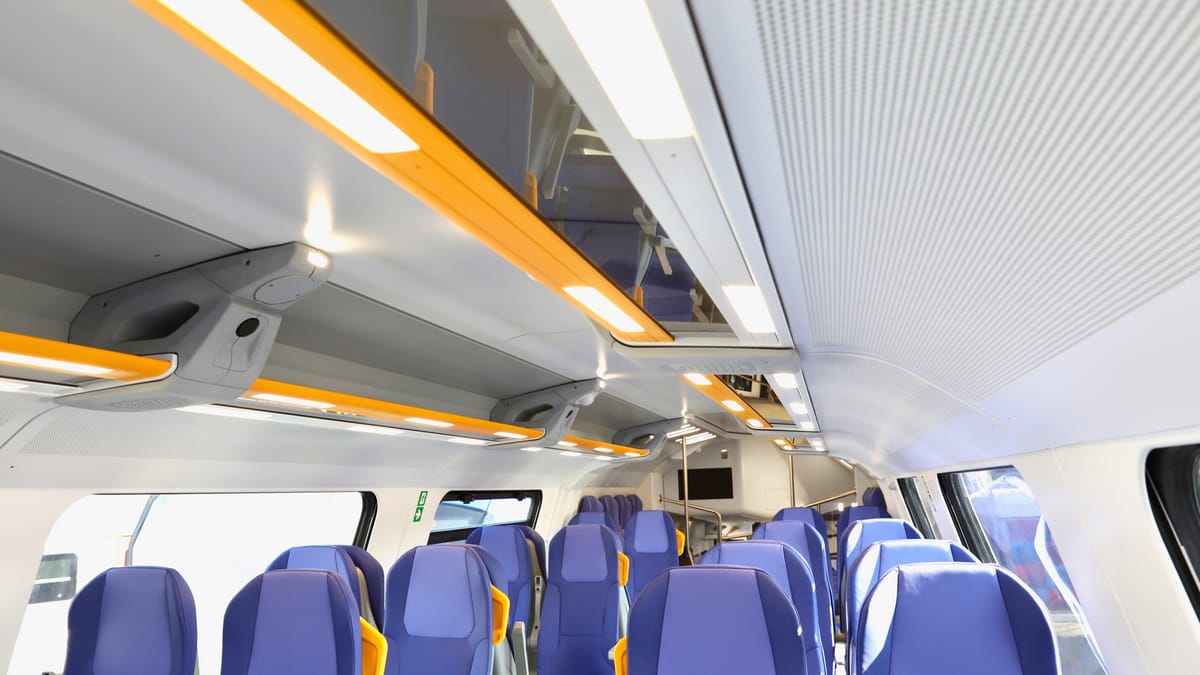
- Scope and Complexity: The term "interiors" in this context is comprehensive. It encompasses the entire internal "skin" of the carriage. This includes the side panels (linings) that insulate the passengers from the outer shell, the ceilings (imperials) which often integrate complex LED lighting channels and HVAC ducting, and the vestibule areas that manage passenger flow.
- Material Science and Safety: These components are not merely aesthetic. They must serve critical structural and safety functions. For instance, the panels must meet stringent Fire, Smoke, and Toxicity (FST) standards to ensure passenger safety in tunnel environments. Furthermore, they contribute significantly to the thermal and acoustic insulation of the train, a key performance indicator for operators like Trenitalia or SNCF.
- Luggage Racks and Partition Walls: Omer manufactures heavy-duty luggage racks that must withstand high static and dynamic loads, particularly in high-speed trains where G-forces can be significant during braking or banking. The partition walls, often integrating glass and aluminum, separate different classes (e.g., Business vs. Standard) and are critical for the modularity of the train configuration.
- Flagship Platforms: The company’s engineering pedigree is validated by its presence on some of the world’s most advanced rail platforms. Omer supplies interiors for the Hitachi ETR 1000 (Frecciarossa 1000), capable of commercial speeds of 360 km/h, where weight reduction is paramount. It is also a key supplier for the Alstom Avelia Liberty, the new high-speed fleet for Amtrak in the United States, and the Hitachi Caravaggio (Rock), a high-capacity regional double-decker train that forms the backbone of Italian regional transport.
2. Toilet Modules (The Technical Niche)
Accounting for approximately 10-12% of revenues, the Toilet Modules segment represents a high value-add niche that demonstrates Omer's systems integration capabilities.
- Systems Integration: Unlike a static wall panel, a toilet module is a dynamic machine. It is a "plug-and-play" unit that must integrate hydraulic water supply systems, pneumatic vacuum waste systems, complex electrical wiring for sensors and automation, and waste management tanks.
- Reliability and Compliance: These units are critical for train availability; a broken toilet can force an operator to take a carriage out of service. Omer designs these modules to be vandal-resistant and fully compliant with Persons with Reduced Mobility (PRM) regulations (TSI PRM).
- Innovation – The MATS System: Omer has moved towards product standardization with its "Modular Aluminium Toilet System" (MATS), developed in partnership with Knorr-Bremse. This shift from bespoke, project-specific designs to a modular platform allows for greater economies of scale and easier maintenance for the operator.
3. Fairings and External Components
Representing roughly 6-10% of sales, this segment deals with the external aerodynamics of the train.
- Aerodynamic Criticality: Components such as the front nose fairings, roof fairings (covering pantographs and HVAC units), and under-carriage skirts are vital for reducing the drag coefficient of the train. In high-speed rail, aerodynamic efficiency directly correlates to energy consumption and noise pollution. Omer’s ability to form complex, sweeping curves using its "Warm Forming" aluminum technology is a key differentiator here.
- Doors: The company also manufactures internal cabin doors and partition doors, which must feature reliable opening mechanisms and safety sensors.
Target Customers and Segmentation
The Customer Profile: The Global OEM Oligopoly
It is crucial to understand that Omer’s direct customer is not the railway operator (e.g., Trenitalia, SNCF, Deutsche Bahn) but the Rolling Stock Manufacturer (OEM). The global railway manufacturing market has undergone significant consolidation, resulting in an oligopoly of Western giants. Omer has successfully positioned itself as a partner to the leaders of this oligopoly.
- Alstom: Following its acquisition of Bombardier Transportation, Alstom has become a dominant force in the industry and a primary client for Omer. The relationship is global, spanning projects from the French TGV and RER commuter lines to the Amtrak high-speed trains in the USA. Omer maintains a dedicated logistics hub in Crespin, France, specifically to service Alstom's production lines, evidencing the symbiotic nature of this relationship.
- Hitachi Rail: A historical and cornerstone partner for Omer, particularly in the Italian market. The partnership is deeply rooted in the development of the ETR 1000 and the Rock/Caravaggio regional platforms. Hitachi's dominance in the Italian high-speed and regional sectors has been a major driver of Omer’s growth.
- Secondary and Emerging Clients: While Alstom and Hitachi dominate the order book, Omer also supplies Siemens, Stadler, and CAF. Expanding the share of wallet with these players is a key strategic objective to dilute the concentration risk.
Why They Buy: The "Co-Design" Imperative
The relationship between Omer and these OEMs is defined by the "Co-Design" model. OEMs do not simply buy parts; they buy engineering capacity and risk mitigation.
- Outsourcing Complexity: Developing a train interior involves balancing conflicting constraints: minimizing weight to reduce axle load and energy usage, maximizing durability to survive 30 years of public use, meeting strict fire safety norms, and achieving a high-end aesthetic finish.
- The Lock-In Effect: OEMs engage Omer in the preliminary design phase, often years before the first metal is cut. Omer’s engineers work alongside the OEM’s team to define the technical specifications. Once Omer’s design is validated and certified for a specific train platform, replacing Omer becomes economically and technically prohibitive. It would require re-engineering the carriage and re-certifying the entire vehicle with safety authorities (e.g., ERA in Europe). This creates a powerful "lock-in" effect that secures revenue for the entire lifecycle of that train platform.
End-Market Segments
- High-Speed Rail: The prestige segment requiring the highest engineering standards (pressure sealing, lightweighting). Omer is a market leader here.
- Regional/Commuter: The volume segment. Projects like the "Rock" involve hundreds of trains, providing long-term manufacturing baseload.
- Metro/Urban: Focused on durability, rapid passenger flow, and vandalism resistance. Examples include the Paris RER and Stockholm Metro C30.
- Luxury Rail: A burgeoning niche. Omer is supplying the interiors for the "La Dolce Vita" Orient Express trains, positioning itself in the ultra-luxury hospitality segment on rails.
2. How They Make Money
Revenue Model: The Long-Cycle Framework Agreement
Omer’s revenue model is a hybrid structure that combines the characteristics of a specialized engineering consultancy with those of a serial industrial manufacturer. The financial lifecycle of a contract mirrors the operational lifecycle of a train project, typically spanning many years.
1. Non-Recurring Engineering (NRE) & Tooling (The Entry Fee)
- Revenue Nature: One-time / Project-based.
- Mechanism: At the inception of a new train platform (e.g., when Hitachi wins the contract to build a new metro), Omer charges for the specific design work. This includes Finite Element Method (FEM) structural analysis, 3D CAD modeling, and the physical creation of the molds and dies required for manufacturing.
- Strategic Importance: While this revenue stream is lumpy, it is strategically vital. By owning the specific tooling and the engineering IP for the components, Omer effectively erects a barrier to entry for any competitor trying to displace them later in the project lifecycle.
2. Serial Production (The Recurring Engine)
- Revenue Nature: Recurring / Volume-based.
- Mechanism: Once the design is frozen and prototypes are approved, the project moves to the "Serial Phase." A single contract might cover the supply of interiors for 50, 100, or 500 trains to be delivered over a period of 3 to 7 years.
- Recognition: Revenue is recognized as "ship-sets" (complete kits for a carriage) are delivered to the OEM’s final assembly line.
- Pricing & Inflation Protection: Pricing is typically fixed in the master framework agreement. However, crucially for an industrial company, Omer builds in price revision formulas (indexation clauses). These formulas link the final price of the component to indices of raw material costs (aluminum), energy prices, and labor inflation. This mechanism was instrumental in 2023 and 2024, where revenue growth was driven not just by volumes but by the activation of these price revisions to offset inflationary pressures, protecting the company's real margins.
3. Spare Parts and Revamping (The Long Tail)
- Revenue Nature: Recurring / Cyclical.
- Mechanism: Trains have operational lifecycles of 30 to 40 years. During this time, interiors suffer wear and tear and require spare parts. Furthermore, at the mid-life point (approx. 15-20 years), operators often commission full "revamping" or refurbishment programs to modernize the fleet. Omer is ideally positioned to win these contracts for the fleets it originally equipped, as it holds the original design data.
Revenue Segments and Share
The revenue breakdown highlights the overwhelming importance of the Interiors division, but also the strategic value of the smaller segments. Based on recent financial data:
| Segment | Share of Revenue | Strategic Role |
|---|---|---|
| Interiors | 76% - 86% | The volume driver and core competency. |
| Toilets | 10% - 12% | High technical complexity, higher value-add per square meter. |
| Fairings & Doors | 6% - 10% | Critical for aerodynamic performance; leverages Warm Forming tech. |
| Other | ~2% - 4% | Engineering fees, prototyping, and aftersales. |
Geographic Source of Revenue:
It is important to distinguish between where the client is and where the train goes. Omer exports deeply, but its revenue is recognized based on the OEM's factory location.
- Italy: ~48% (Driven by Hitachi’s factories in Pistoia and Reggio Calabria).
- France: ~21% (Driven by Alstom’s massive industrial footprint in France).
- USA & Canada: ~5% (A rapidly growing segment due to the Chicago Metra contract and "Buy American" requirements).
- Rest of Europe: Includes Germany (Siemens) and the UK.
3. Quality of Revenue
Predictability: The Fortress of the Backlog
The single most compelling attribute of Omer’s financial profile is the exceptional visibility of its revenue stream. The company operates on what it terms a "backlog-based business model," which insulates it from short-term economic fluctuations.
- Total Backlog Magnitude: As of the first quarter of 2024, Omer reported a combined backlog (Hard + Soft) of approximately €370 million.
- Coverage Ratio: When compared to the FY2023 revenue base (approx. €67 million), this backlog provides a coverage ratio of roughly 5.5 years. This is an extraordinary figure for a manufacturing company, implying that the factories are theoretically booked well into the latter half of the decade.
- The "Soft" to "Hard" Conversion: The backlog is split into two categories:
- Hard Backlog (€124m): These are signed purchase orders for production. They are legally binding.
- Soft Backlog (€246m): These represent options within signed framework agreements. While technically not yet "ordered," Omer reports a historical conversion rate of 100% from Soft to Hard backlog. In the railway industry, once a supplier is "designed in" to a platform (the Soft Backlog phase), the OEM rarely, if ever, switches suppliers for the optional tranches. The cost of re-certification and the risk of production disruption make switching suppliers mid-program irrational for the OEM. Thus, the "Soft" backlog is functionally high-quality revenue in waiting.2
Diversification vs. Concentration
While the predictability of revenue is high, the diversification is the company's primary structural weakness.
- Customer Concentration: The revenue base is highly concentrated, with the top two customers (Alstom and Hitachi) consistently accounting for over 90% of total turnover. This creates a binary risk profile: Omer is deeply integrated with the winners of the current rail market, but it lacks a hedge if these giants were to lose market share or face internal crises.
- Geographic Diversification: This is improving. The expansion into the USA with the Chicago Metra contract (Alstom) helps balance the heavy exposure to the European market. The US market is protected by "Buy American" laws, meaning that once Omer established its US plant, it gained access to a protected profit pool that Asian or European-only competitors cannot touch.
Dependence on Economic Cycles
Omer’s revenue is largely decoupled from the short-term business cycle.
- Public Infrastructure Spending: Demand for trains is driven by long-term government infrastructure plans (e.g., Italy’s PNRR, the US Infrastructure Bill, the EU Green Deal). These investments are often counter-cyclical, used by governments to stimulate the economy during downturns.
- Secular Tailwinds: The shift towards sustainable mobility is a multi-decade trend that transcends varying GDP growth rates.
4. Cost Structure
Key Cost Components
Omer’s cost structure is typical of a high-value-added transformation industry, characterized by significant raw material inputs and a skilled labor force.
1. Raw Materials (Variable)
- Aluminum Dominance: The primary cost driver is aluminum (alloys, extrusions, and sheets). Production costs, which are dominated by materials, typically consume between 35% and 43% of revenues.
- Inflation Management: The volatility of aluminum prices is a key risk. However, Omer manages this through the aforementioned pass-through clauses in its contracts. While there may be a lag of a few months (a "mismatch" period) between a price spike and the contract adjustment, the structural margin is protected over the medium term.
2. Personnel (Semi-Fixed)
- Skilled Workforce: Omer employs approximately 350 people. The nature of the work—welding aluminum to certified standards, precise "Warm Forming," and complex assembly—requires a skilled, permanent workforce rather than temporary labor.
- Cost Trends: Labor costs have been rising in absolute terms. This is due to two factors: wage inflation and the strategic strengthening of the organizational structure (hiring more engineers and project managers) to handle the increasing complexity of international projects like the US expansion.
3. Energy and Overhead
- Energy Intensity: The "Warm Forming" process involves heating aluminum to ~250°C, which is energy-intensive.
- Mitigation Strategy: Omer has invested in a 1 Megawatt photovoltaic system at its Carini plant. This system generates more than 60% of the energy required for production from renewable sources, significantly insulating the company’s cost base from spikes in electricity prices and enhancing its ESG profile.
Margin Profile and Scalability
- EBITDA Margin Strength: Despite the inflationary environment of 2022-2024, Omer has successfully maintained EBITDA margins in the 20% to 22% range. This is a standout metric in the industrial sector, where margins of 10-15% are more common.
- Drivers of Margin: This superior profitability is driven by the "technology premium" of the Warm Forming process (which creates value that simple metal bending cannot) and the operational leverage of the expanded Carini facility.
- Scalability: The expansion of "Plant B" in Carini increased production capacity by approximately 200%. As production volumes ramp up to fill this capacity (revenue grew from €63m in 2022 to €84m in 2024), the fixed costs of the plant are spread over a larger revenue base, theoretically supporting margin expansion or at least stability in the face of rising input costs.
5. Capital Intensity
Asset Base and Industrial Footprint
Omer operates a capital-intensive business model that requires specialized industrial real estate and heavy machinery. The company has recently completed a major investment cycle, positioning it with a modern, high-capacity asset base.
Production Sites
- Carini Plant A (Italy): The historical headquarters and original production site.
- Carini Plant B (Italy): A massive expansion completed around 2020 with an investment of approximately €9 million. This facility covers 59,000 square meters (21,500 sqm covered) and houses state-of-the-art painting booths, welding stations, and assembly lines. This plant represents the engine for future growth, having tripled the company's theoretical capacity.
- Sterling Heights, Michigan (USA): A 3,000 square meter facility dedicated to the North American market. This plant is a strategic asset required to meet "Buy American" local content rules. It focuses on final assembly and finishing of components for US contracts like the Chicago Metra.
- Logistics Hubs: Omer operates a logistics facility in Crespin, France, strategically located near Alstom’s major factory, enabling Just-In-Time (JIT) delivery and cementing its role as a strategic partner.
Capex Cycle
- Current Status: Omer is currently post-peak in its heavy infrastructure Capex cycle. The heavy lifting of building Plant B is complete.
- Implication: Future Capital Expenditure will likely be focused on maintenance and, more significantly, on project-specific tooling (which is often recharged to the client via NRE fees). This structural reduction in Capex requirements should support strong Free Cash Flow (FCF) generation in the coming years.
Working Capital Dynamics
- Trend: Net Working Capital (NWC) has shown a rising trend, increasing from €19.2 million in 2023 to €27.9 million in 2024.
- Driver: This increase is not a sign of inefficiency but a reflection of growth and specific project phasing. The 2024 increase was explicitly linked to the production ramp-up of the "Dolce Vita" luxury train project, which required significant inventory build-up and engineering outlay in Q4 2024 before delivery.
- Cash Conversion: In the railway industry, working capital is cyclical. It swells as inventory is built for a new fleet and releases as ship-sets are delivered and invoiced. Omer’s ability to finance this working capital internally, without resorting to heavy debt, is a key strength.
6. Growth Drivers
1. Structural Industry Tailwinds (The Green Deal)
- Mechanism: The global push for decarbonization identifies rail as the most sustainable mode of mass transport. The European Union’s "Green Deal" and "Fit for 55" packages mandate a significant shift of freight and passenger traffic from road and air to rail.
- Impact: This translates into massive public funding for new high-speed lines (e.g., Lyon-Turin, HS2 in the UK) and the modernization of regional fleets. As the total addressable market (TAM) for trains grows, the TAM for Omer’s interiors grows directly in proportion.
2. Geographic Expansion: The American Dream
- Mechanism: The contract to supply interiors for 221 double-decker cars for Chicago’s Metra (via Alstom) is a watershed moment. It proves that Omer can successfully bid for and execute large-scale US projects using its Sterling Heights facility.
- Upside: The US passenger rail market is underdeveloped compared to Europe but is receiving historic investment levels under the Bipartisan Infrastructure Law. Omer is now a qualified "local" player, positioning it to bid for future high-speed projects in California or the Northeast Corridor.
3. Segment Diversification: Luxury and Revamping
- Luxury Rail: The supply of interiors for the "La Dolce Vita" Orient Express is a strategic entry into the ultra-luxury segment. While the volumes are lower than commuter trains, the value-add per square meter is significantly higher, and the project serves as a global marketing flagship for Omer’s design capabilities.
- Revamping: Europe’s train fleets are aging. There is a growing market for "mid-life upgrades" where the chassis is kept but the interior is stripped and replaced. Omer is targeting this "revamping" market as a source of recurring revenue that is independent of new train orders.
4. Pricing Power and Inflation Pass-Through
- Mechanism: Omer’s ability to revise contract prices in line with inflation is a growth driver in nominal terms. It ensures that the company’s top line grows with the economy even if volume growth were to temporarily stall, protecting the real value of its earnings.
7. Competitive Advantages
1. Proprietary Technology: "Warm Forming"
Omer possesses a distinct technological moat in its manufacturing process for aluminum, known as "Warm Forming."
- The Problem: Aluminum is lightweight and corrosion-resistant, making it ideal for trains. However, it is notoriously difficult to shape into complex, aerodynamic curves.
- Cold Forming (Room Temp): Cheap but limited. The metal "springs back," making precise, complex curves impossible.
- Super Forming (450°C): Allows complex shapes (plastic state) but is extremely slow, energy-intensive, and expensive.
- Omer’s Solution: Omer developed and patented a hybrid "Warm Forming" process that operates at intermediate temperatures (approx. 250°C).
- The Advantage: This process sits in the "Goldilocks" zone. It allows for the complex, aerodynamic shapes required for high-speed rail interiors and fairings (which Cold Forming cannot do) but at a much faster cycle time and lower energy cost than Super Forming. This gives Omer a unique cost-to-performance ratio that commodity metal benders cannot match, protecting its margins.
2. The "Design-In" Switching Cost
- Mechanism: Omer does not just bid on blueprints; it helps draw them. By utilizing its 34-engineer strong R&D department to co-design the interior with the OEM before the tender is even finalized, Omer embeds its intellectual property into the vehicle's certification.
- Stickiness: Once a train platform is certified (e.g., the ETR 1000), the interior components are part of the homologated vehicle file. Switching to a cheaper supplier for the next batch of trains would require the OEM to re-validate the fire safety, structural integrity, and crashworthiness of the new components—a process costing millions and taking months. This creates extremely high switching costs.
3. Certification Barriers
- Regulatory Moat: The railway industry is as regulated as aviation. Omer holds all critical certifications, including IRIS (ISO 22163), ISO 3834-2 (welding of railway vehicles), and DIN 6701 (adhesive bonding of railway vehicles). Achieving and maintaining these certifications requires years of audits and rigid quality management systems, effectively barring new, low-cost entrants from the market.
8. Industry Structure and Position
Value Chain Analysis
- Upstream (Raw Materials): Suppliers of aluminum and resins. This is a commodity market where Omer is a price taker, though it hedges risk via pass-through clauses.
- Midstream (Tier 1 Suppliers - Omer): Companies that integrate raw materials into complex, engineered systems. The profit pool here is driven by engineering value-add.
- Downstream (OEMs): The giants like Alstom, Hitachi, Siemens. They hold the power of the purse but are dependent on reliable Tier 1s to execute their massive backlogs.
- End-User (Operators): Trenitalia, SNCF, Amtrak. They demand reliability and passenger comfort.
Market Structure: Consolidated Oligopoly
The downstream market is an oligopoly. The "Big Three" in Europe (Alstom, Siemens, Hitachi) control the vast majority of the market.
- Omer’s Position: Omer has graduated from being a local Italian supplier to a Global Strategic Partner. It is one of the few independent players with the scale (350+ staff, international footprint) to handle the interior supply for entire fleets (e.g., 146 trains for Paris RER).
- Competitors:
- In-House: OEMs sometimes manufacture interiors internally, but the trend is outsourcing to variabilize costs.
- Multi-Nationals: Knorr-Bremse (competitor in toilets/systems), Wabtec.
- Niche Players: Teknoware (lighting/interiors), Tabb Interiors, and various smaller, local metalworking shops that lack Omer’s engineering depth.
Pricing Power
Omer is not a price setter in the absolute sense (the OEM sets the budget), but it has pricing resilience. Because its products are co-designed and critical for the train's certification, it faces less pricing pressure than a supplier of commoditized bolts or brackets. The existence of inflation indexation in its contracts is evidence of this balanced power dynamic.
9. Unit Economics and Key Performance Indicators
Key Metrics
- Backlog Coverage Ratio: 5.5x. This is the primary KPI for risk assessment. It indicates that the company’s medium-term survival and revenue baseline are secured by existing contracts.
- Soft-to-Hard Conversion Rate: 100%. This metric validates the "stickiness" thesis. It proves that "options" in contracts are virtually guaranteed revenues.
- EBITDA Margin: ~20-22%. This metric demonstrates the efficiency of the manufacturing process (Warm Forming) and the value of the engineering IP. It has remained stable despite revenue growth, indicating that the company can scale without sacrificing profitability.
- Revenue per Employee: With ~350 employees and ~€84 million in revenue (2024), Omer generates approximately €240,000 per employee. This is a healthy figure for a manufacturing firm, indicating high labor productivity and value-add.
Trends
- Improving: Revenue scale is accelerating (+25% YoY in 2024).
- Stabilizing: Margins are holding firm in a high-inflation environment, proving the robustness of the business model.
- Watching: Working capital intensity has increased. While explained by the "Dolce Vita" project, investors should watch for the unwinding of this inventory into cash in 2025/2026.
10. Capital Allocation and Balance Sheet
Balance Sheet Strength: The Cash Anomaly
Omer maintains a balance sheet that is exceptionally robust, creating a "safety net" for the equity story.
- Net Financial Position (NFP): Positive (Net Cash). As of year-end 2024, the company held a Net Cash position of €19.9 million. This means it has more cash than financial debt.
- Cash Pile: Cash and equivalents stood at €18.5 million.
- Leverage: The company effectively has negative leverage. Long-term financial debt is negligible (€0.6m). This insulates the company from the current high-interest-rate environment; while peers with debt are paying higher interest expenses, Omer is earning interest on its cash.
Capital Allocation Strategy
- Organic Growth (Priority): The company has reinvested heavily in itself (Plant B, US Plant). This phase is largely complete.
- Dividends (Shareholder Returns): Omer has adopted a progressive dividend policy, sharing the fruits of its growth with investors.
- 2023 Payment: €0.05 per share
- 2024 Payment: €0.06 per share (+20%)
- 2025 Proposed: €0.07 per share (+16.7%).
- Share Buybacks: The company is active in buying back its own shares, a signal that management believes the stock is undervalued. As of 2024/2025, active buyback programs were in place to support liquidity and service incentive plans.
- Value Creation Assessment: The allocation strategy has been highly value-accretive. Management used the IPO proceeds and internal cash flow to build a world-class factory (Plant B) without taking on debt, and is now returning the excess cash to shareholders via growing dividends.
11. Risks and Sources of Error
1. Customer Concentration (The Critical Risk)
- The Risk: Alstom and Hitachi account for >90% of revenue. Omer is a "derivative" play on these two companies.
- Failure Scenario: If Hitachi were to lose its dominance in the Italian high-speed market to a competitor like CAF (and Omer fails to win CAF’s business), or if Alstom decides to insource interior production to fill its own factories during a downturn, Omer’s revenue could contract structurally.
- Mitigant: The "Co-Design" lock-in mitigates sudden shocks, but the long-term strategic risk remains high.
2. Raw Material Volatility & Lag
- The Risk: A sudden, violent spike in aluminum prices (e.g., due to geopolitical sanctions) could compress margins in the short term.
- Mechanism: While price revision clauses exist, they often operate with a lag (e.g., prices are adjusted quarterly or semi-annually). In a hyper-inflationary spike, Omer would absorb the cost for a few months before the revenue adjustment kicks in.
3. Execution Risk on International Expansion
- The Risk: Managing a factory in Detroit is different from managing one in Sicily. Risks include labor union dynamics, higher US wage inflation, and the logistical complexity of managing a trans-Atlantic supply chain.
- Uncertainty: Information on the specific profitability of the US subsidiary is limited compared to the consolidated group.
4. Liquidity and Control
- The Risk: Omer is a small-cap stock controlled by the Russello family (Halfa S.r.l. owns ~73.6%). The free float is only ~25%.
- Implication: The stock is illiquid. Large institutional investors cannot build or exit positions easily. Additionally, the company is not "contestable"—it cannot be taken over without the family's consent, limiting the potential for an M&A premium unless the family decides to sell.
12. Valuation and Expected Return Profile
Current Valuation Metrics
- Market Cap: Approx. €106 - €110 million (based on share price range of €3.70 - €3.80).
- Enterprise Value (EV): Approx. €88 million (Market Cap minus ~€20m Net Cash).
- EV/EBITDA: Trading at approximately 4.7x - 5.4x LTM EBITDA.
- P/E Ratio: ~10x.
- Dividend Yield: ~1.85% (growing).
Comparative Valuation
Omer trades at a deep discount relative to its larger peers and the broader industrial sector.
- Peer Group: Major rail suppliers like Knorr-Bremse or Wabtec often trade at 13x - 17x EV/EBITDA.
- The Discount: Omer trades at <50% of the valuation of its large peers. This discount is the market's price for the "Small Cap Liquidity Risk" and the "Customer Concentration Risk."
- Assessment: While a discount is warranted, a gap of this magnitude (5x vs 13x) appears excessive given Omer’s superior margins (20% vs sector avg ~14%) and cleaner balance sheet.
Scenario Framework
| Scenario | Assumptions | Valuation Multiple | Implied Price Target | Potential Return |
|---|---|---|---|---|
| Bear Case | Alstom insources production; US execution fails; Margins compress to 15%. | 3.5x EV/EBITDA | ~€2.50 | -30% |
| Base Case | Backlog executes as planned; Margins stable at 20%; Moderate US growth. | 5.5x EV/EBITDA | ~€4.20 | +12% |
| Bull Case | Market re-rates Small Caps; New client win (Siemens/CAF); Margins expand to 23%. | 7.5x EV/EBITDA | ~€5.80 | +55% |
13. Catalysts and Time Horizon
Short-Term Catalysts (6-12 Months)
- Dividend Payment: The distribution of the €0.07 dividend in May 2025 will confirm the company's cash generation confidence.
- New Orders: Any announcement of a contract with a third OEM (e.g., Siemens or CAF) would be a major catalyst. It would directly address the "concentration discount" and likely trigger a multiple re-rating.
- US Milestones: Successful delivery of the first batches for the Chicago Metra contract will de-risk the US expansion narrative.
Slow-Acting Catalysts (Medium Term)
- Operational Leverage: As volumes in the new Plant B continue to rise, investors will watch for margin expansion beyond the 22% ceiling, which would signal exceptional operational efficiency.
- M&A Target: Given its strategic technology, low valuation, and relationships with key OEMs, Omer is a prime target for acquisition by a larger group (like Knorr-Bremse or a private equity firm focused on industrials) looking to consolidate the supply chain.
Time Horizon
This is a Medium-to-Long Term (2-5 Years) investment thesis. The "backlog" nature of the business means that the value creation is slow and steady. The market may take time to close the valuation gap, likely waiting for consistent proof of diversification or a shift in sentiment towards European small caps. However, the downside is protected by the net cash and the backlog, offering a "wait and get paid" (dividend) profile.
References
- equity research - OMER SPA, Accessed January 20, 2026, https://omerspa.com/wp-content/uploads/2023/11/Davide-Longo_Initiation-of-Coverage-06112023.pdf
- Presentazione standard di PowerPoint - OMER SPA, accessed January 20, 2026, https://omerspa.com/wp-content/uploads/2024/06/20240620-Omer_Roadshow-Intermonte.pdf
- Omer railway interiors, Accessed January 20, 2026, https://omerspa.com/wp-content/uploads/2023/04/OMER-brochure-Railway-Interiors_c.pdf
- company presentation - OMER SPA, Accessed January 20, 2026, https://omerspa.com/wp-content/uploads/2021/09/202109_Omer_Company-Presentation.pdf
- Omer SpA, accessed January 20, 2026, https://omerspa.com/en/
- Press release - Omer is attending the international InnoTrans trade fair in Berlin and participating in Alstom's alliance programme., Accessed January 20, 2026, https://omerspa.com/wp-content/uploads/2024/09/20240927-PR-OMER_Innotrans_eng.pdf
- Omer SpA investor presentation, accessed January 20, 2026, https://omerspa.com/wp-content/uploads/2025/05/20250516-Omer_Investor-Presentation-TP-ICAP-Midcap-Conference-v2.pdf
- Regional Trains Interiors - OMER SPA, Accessed January 20, 2026, https://omerspa.com/en/products/regional-trains-interiors/
- Presentazione standard di PowerPoint - OMER SPA, Accessed January 20, 2026, https://omerspa.com/wp-content/uploads/2024/10/20241024-Omer_Roadshow-TP-ICAP-Midcap.pdf
- Omer expands in US with Alstom Contract - Nasdaq, Accessed January 20, 2026, https://www.nasdaq.com/articles/omer-spa-expands-us-alstom-contract
- fy 2024 results - OMER SPA, Accessed January 20, 2026, https://omerspa.com/wp-content/uploads/2025/03/20250320-Omer_FY2024-Results-def.pdf
- Railway Interiors Market Size, Share, Trends & Growth Forecast 2032 - MarketsandMarkets, Accessed January 20, 2026, https://www.marketsandmarkets.com/Market-Reports/railway-interiors-market-36716491.html
- PRESS RELEASE THE BOARD OF DIRECTORS APPROVES THE DRAFT FINANCIAL STATEMENTS AND THE CONSOLIDATED FINANCIAL STATEMENTS AS OF 31s - OMER SPA, Accessed January 20, 2026, https://omerspa.com/wp-content/uploads/2025/03/20250319-OMER-Results-FY-2024.pdf
- OMER S.p.A. dividends | Digrin, Accessed January 20, 2026, https://www.digrin.com/stocks/detail/OMER.MI/
- Omer Spa (OMR) Stock Dividend History & Date 2025 - Investing.com, Accessed January 20, 2026, https://www.investing.com/equities/omer-spa-dividends
- Share buyback programme - Mediobanca Group, Accessed January 20, 2026, https://www.mediobanca.com/en/corporate-governance/shareholders/share-buyback-programme.html
- LAUNCH OF A NEW SHARE BUYBACK PROGRAM FOR 20 MILLION EUROS - OVS Corporate, Accessed January 20, 2026, https://www.ovscorporate.it/sites/default/files/documents/2025-06/ovs_spa_press_release.pdf
- Shareholders - OMER SPA, Accessed January 20, 2026, https://omerspa.com/en/investor-relations-en/shareholders/
- OMER (DB:9WR) Stock Valuation, Peer Comparison & Price Targets - Simply Wall St, Accessed January 20, 2026, https://simplywall.st/stocks/de/capital-goods/fra-9wr/omer-shares/valuation
- OMER Stock Price Quote | Morningstar, Accessed January 20, 2026, https://www.morningstar.com/stocks/xmil/omer/quote
- OMER EV/EBITDA - Omer SpA - Alpha Spread, Accessed January 20, 2026, https://www.alphaspread.com/security/mil/omer/relative-valuation/ratio/enterprise-value-to-ebitda
- Omer - Public Comps and Valuation Multiples, Accessed January 20, 2026, https://multiples.vc/public-comps/omer-valuation-multiples